.webp)
Overview: Critical Importance of Seal and Fluid Compatibility
Hydraulic seal materials and fluid chemistry represent one of the most frequently overlooked—yet critically important—aspects of tilt cylinder specification and maintenance. Using incompatible seal materials with the wrong hydraulic fluid type causes catastrophic seal failure within hours to days of operation: seals swell dramatically or shrink to non-functional dimensions, creating pressure loss and complete system failure. Conversely, correctly matched seal materials and fluid chemistry enable extended component lifespan, predictable performance across temperature extremes, and reliable operation across demanding industrial environments.
Tilt cylinder seal materials fall into four primary categories: nitrile (NBR) for petroleum-based systems, polytetrafluoroethylene (PTFE) for extended temperature and chemical compatibility, polyurethane (PU) for precision applications, and fluoroelastomer (Viton) for high-temperature and aggressive chemical environments. Each material exhibits distinct viscosity-temperature characteristics, chemical compatibility profiles, and pressure performance boundaries that must be carefully matched to the specific hydraulic fluid type and operational temperature range of the intended application.
Nitrile (NBR) Seals: Standard Industrial Application
Nitrile (acrylonitrile-butadiene rubber) represents the most common tilt cylinder seal material, used in approximately 75% of industrial hydraulic cylinders designed for petroleum-based mineral oil systems. Nitrile exhibits excellent compatibility with conventional petroleum-based hydraulic fluids, moderate cost ($100-$150 for standard seal kits), and adequate performance across typical warehouse temperature ranges (50-60°C / 122-140°F operating envelope).
Nitrile Performance Characteristics:
Temperature Range: Standard nitrile seals operate reliably from -20°C to +80°C (-4°F to +176°F), with optimal performance in the 50-60°C (122-140°F) range. At temperatures above 80°C, nitrile begins to harden and lose elasticity, degrading sealing capability. Below -20°C, nitrile becomes brittle and loses flexibility, increasing leak risk. Extended temperature applications require specialty formulations or alternative materials.
Fluid Compatibility: Nitrile seals are chemically compatible with mineral oil-based hydraulic fluids (ISO VG 32, 46, 68) used in approximately 95% of industrial forklifts. The petroleum base of these fluids slightly swells nitrile, maintaining seal pressure and leakage prevention. This compatibility is absolute and non-negotiable: nitrile seals will swell significantly and lose sealing capability within hours if exposed to biodegradable HETG fluids, synthetic PAO, or phosphate ester-based fluids commonly found in fire-resistant systems.
Pressure Performance: Nitrile seals maintain functional integrity up to 2,500 PSI continuous operation, with brief excursions to 3,000 PSI acceptable for proportional control applications. Sustained pressure above 2,500 PSI accelerates wear rates and reduces component lifespan by 30-50% compared to normal pressure operation. Pressure cycling stress (multiple tilt cycles per hour) progressively hardens nitrile materials, reducing elasticity and increasing leakage gradually over 24-36 months of intensive use.
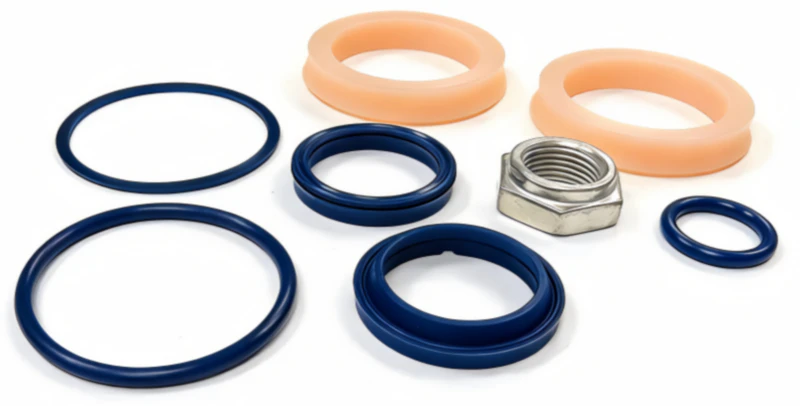
PTFE (Polytetrafluoroethylene) Seals: Extended Range Application
PTFE seals (commonly known by the DuPont trademark Teflon) provide extended temperature range, superior chemical compatibility, and compatibility with multiple hydraulic fluid types. PTFE-based seals cost $250-$350 for complete seal kits, representing 2-3x premium over nitrile materials, but justify the investment through extended temperature range and broader fluid compatibility enabling equipment flexibility across diverse operational environments.
PTFE Seal Characteristics and Advantages:
Extreme Temperature Performance: PTFE seals operate reliably from -40°C to +120°C (-40°F to +248°F), providing 40-60 degree Celsius extended range above and below nitrile limitations. This broad temperature range enables operation in arctic cold storage facilities, desert heat environments, or proximity to thermal processes where nitrile would fail. Arctic operations (outdoor equipment, winter storage) and thermal proximity applications (proximity to furnaces, hot forming equipment) specifically benefit from PTFE’s extended low and high temperature capabilities.
Universal Fluid Compatibility: Unlike nitrile’s petroleum-oil-only limitation, PTFE seals exhibit chemical resistance across petroleum mineral oil, biodegradable HETG, synthetic PAO, and phosphate ester-based fire-resistant fluids. This universal compatibility enables equipment flexibility: same cylinder can be used across diverse hydraulic systems without seal material compatibility concerns. This is particularly valuable in rental equipment fleets or multi-system facilities where cylinders may encounter different fluid types during service life.
Reduced Swelling and Leakage: PTFE exhibits minimal swelling response to fluid chemistry variation, maintaining consistent seal dimensions regardless of fluid type. This dimensional stability prevents gradual seal loosening (which occurs with nitrile as fluid chemistry changes) and provides more consistent pressure retention across extended service intervals.
Chemical Attack Resistance: PTFE’s fluorine-carbon backbone provides exceptional resistance to chemical attack from hydraulic fluid additives, oxidation products, and contamination. This chemical resistance is particularly valuable in high-temperature environments where fluid oxidation products accumulate faster, or in aggressive industrial environments where acidic contamination occurs.
Limitations and Maintenance Considerations: PTFE seals are slightly less compliant than nitrile, requiring precision installation and careful dimensional control to achieve optimal sealing. Lower compliance also means reduced margin for error in installation procedures—slightly oversized cylinders or misaligned mounting can compromise sealing more readily than with nitrile’s greater elasticity tolerance. PTFE seals also cost 2-3x more to replace, and specialized seal kits for PTFE may have longer procurement lead times compared to standard nitrile availability.
Polyurethane (PU) Seals: Precision Control Applications
Polyurethane seals combine high elasticity with precision dimensional control, enabling smoother and more responsive hydraulic operation. Used primarily in proportional control cylinders where smooth load positioning and micro-speed regulation are critical, polyurethane seals cost $200-$280 per seal kit and require petroleum-based mineral oil systems similar to nitrile compatibility requirements.
Polyurethane Characteristics:
Superior Elasticity and Low Friction: Polyurethane exhibits greater elasticity than nitrile, conforming precisely to piston rod surface irregularities and providing smoother sliding action with lower friction coefficient. This low-friction characteristic is valued in proportional control applications where smooth spool response and precise flow regulation are required. Equipment using proportional directional control valves specifically benefits from polyurethane’s low-friction characteristics enabling responsive operator control.
Temperature Range: Polyurethane seals operate from -30°C to +100°C (-22°F to +212°F), providing extended range above nitrile but not quite matching PTFE’s extreme cold performance. The upper temperature limit of 100°C makes polyurethane suitable for warm environments but not extreme-heat applications.
Fluid Compatibility: Polyurethane requires petroleum-based mineral oil systems, exhibiting incompatibility with biodegradable and synthetic fluids similar to nitrile constraints. Systems using biodegradable or synthetic fluids cannot substitute polyurethane seals as solution—fluid type must be addressed through equipment selection or complete system conversion.
Precision Control Value Proposition: Equipment using proportional control valves, proportional pressure-reducing valves, or advanced load-sensing systems specifically benefits from polyurethane’s superior control characteristics. The improved positioning precision and smooth operator response justify premium cost ($80-$130 additional per seal kit compared to nitrile) in high-performance warehouse equipment where load positioning precision drives operational efficiency.
Fluoroelastomer (Viton) Seals: High-Temperature and Aggressive Environments
Fluoroelastomer (Viton is the DuPont trademark, with other suppliers using alternative names like FKM or fluorocarbon) provides premium performance for extreme temperature environments and aggressive chemical exposure. Viton seal kits cost $400-$600, representing 4-5x premium over nitrile, but are essential for applications with sustained high temperatures or exposure to aggressive contamination.
Viton Seal Performance Characteristics:
Extreme High-Temperature Performance: Viton seals maintain functional integrity up to +150°C (+302°F) continuous operation, with brief excursions to +200°C acceptable. This temperature capability enables operation in applications with thermal exposure: proximity to furnaces or hot-forming equipment, thermal processing facilities, or tropical climates with persistent high ambient temperatures. Viton degradation rate below 120°C is minimal, approaching synthetic oil longevity in extended high-temperature service.
Broad Fluid Compatibility: Viton seals are compatible with petroleum mineral oils, biodegradable HETG fluids, and phosphate ester fire-resistant fluids. This broad compatibility enables Viton specification for fire-resistant hydraulic systems common in steel mills, foundries, and industrial heat-processing equipment where fire risk demands non-flammable fluid systems.
Chemical Resistance: Viton exhibits superior resistance to chemical attack from fuel, solvents, oxidation products, and aggressive fluid additives. Equipment operating in corrosive or chemically aggressive environments specifically benefits from Viton’s chemical resistance preventing degradation from exposure to contaminants that would rapidly damage nitrile seals.
Cost-Benefit Justification: Viton premium ($300-$500 additional per seal kit compared to nitrile) is justified only in extreme-temperature or aggressive-environment applications. Standard warehouse environments operating at normal temperatures (50-60°C) see no performance benefit from Viton, making it an unjustified expense in typical industrial applications. However, specialized environments with sustained high temperatures or chemical exposure derive compelling value from Viton’s extended capability.
Hydraulic Fluid Types and Seal Material Matching
Hydraulic fluid types define the constraints on seal material selection through chemical compatibility requirements. Attempting to use incompatible seal materials with wrong fluid types creates predictable failure patterns within hours of pressurization.
Petroleum Mineral Oil Systems (ISO VG 32, 46, 68): Most common fluid type in industrial forklifts, approximately 95% of equipment worldwide. Compatible seal materials: nitrile (standard), polyurethane (precision control), PTFE (extended temperature), or Viton (high-temperature). Cost consideration: nitrile is lowest-cost solution for standard applications; PTFE or Viton specified only for extended temperature or chemical exposure requirements.
Biodegradable HETG Fluids (Polyol Ester Base): Increasing requirement in European environmental regulations and marine/coastal applications where biodegradability is mandated. Compatible seal materials: PTFE only (nitrile causes immediate catastrophic swelling, complete sealing failure within minutes). Cost implications: PTFE seal kits ($250-$350) are mandatory, increasing seal replacement cost 2-3x compared to nitrile systems. Equipment conversion to biodegradable fluid requires complete seal kit replacement—attempting to use existing nitrile seals with biodegradable fluid is absolutely forbidden.
Synthetic PAO (Polyalphaolefin) Fluids: Used in applications requiring extended fluid life and superior thermal stability (often cold-climate equipment or high-stress applications). Compatible seal materials: PTFE or Viton (nitrile exhibits marginal compatibility with some PAO formulations, but PTFE is recommended to eliminate compatibility risk). Cost consideration: PTFE seals recommended despite higher cost, to eliminate degradation risk from synthetic fluid exposure.
Fire-Resistant Phosphate Ester Fluids: Mandated in steel mills, foundries, and fire-critical industrial environments where non-flammable hydraulic fluid is essential safety requirement. Compatible seal materials: Viton only (nitrile and PTFE both exhibit compatibility issues with phosphate ester aggressive chemistry). Cost implications: Viton seal kits ($400-$600) plus fire-resistant fluid premium ($2-$3 per gallon vs. $0.50-$1.00 for mineral oil) create 5-10x total system cost premium compared to standard mineral oil systems.
Seal Selection Decision Framework and Documentation Requirements
Proper seal and fluid compatibility management requires systematic documentation and verification procedures preventing inadvertent incompatibility during maintenance operations. Seal material selection should be explicitly documented at equipment startup, verified during every replacement cycle, and included in maintenance records ensuring that technicians performing seal replacement work have clear guidance on required material types.
Required Documentation: Equipment nameplate should display hydraulic fluid type and approved seal materials. Maintenance records should document seal material used during installation. Parts inventory should organize replacement seal kits by material type with clear labeling preventing cross-contamination in the parts room. Technician training should emphasize consequences of seal-fluid incompatibility and include explicit warnings about biodegradable fluid conversion procedures requiring complete seal kit replacement.
Fluid Conversion Procedures: Converting equipment from mineral oil to biodegradable or other alternative fluids requires complete hydraulic system flush, seal kit replacement, filter element upgrade (different filter ratings for different fluid types), and pressure testing verification before return to service. This conversion process typically costs $1,500-$3,500 in labor and materials, making it economically significant—fluid system change is not a simple fluid-only substitution but rather a complete system upgrade requiring comprehensive procedures.
Performance Verification and Seal Material Testing
After seal replacement or during equipment commissioning with new cylinders, pressure testing and operational verification confirm that seal materials are functioning correctly in the installed fluid environment. Early detection of seal incompatibility (manifesting as rapid pressure loss within hours of commissioning) enables correction before seal damage becomes catastrophic.
Connect pressure gauges immediately after installation commissioning and document baseline pressure readings. Pressure should be stable within 50 PSI over 30 minutes of idle operation at 50% system pressure. If pressure decreases more rapidly, internal seal leakage is occurring and requires investigation: verify that correct seal materials are installed, confirm fluid type matches seal specification, and test for contamination in the hydraulic fluid that might cause seal swelling or degradation.
Professional Specification and Application Support
Seal material and fluid compatibility decisions involve technical nuance that benefits from professional consultation when equipment configuration or operating environment presents non-standard requirements. Contact tiltcylinder.net’s technical team at our contact page to discuss seal material requirements for your specific hydraulic fluid type and operating environment. Our engineers can recommend optimal seal materials balancing performance, cost, and compatibility requirements for your application.
Visit our resource center for detailed seal specification sheets and fluid compatibility matrices. For integrated hydraulic system design guidance and component compatibility planning, explore compatible bearing systems documentation for complete equipment architecture optimization.
Conclusion: Critical Matching of Seals and Fluids for Reliability
Tilt cylinder seal material and hydraulic fluid compatibility represents a critical decision point determining whether cylinder replacement will deliver expected performance and operational lifespan or result in rapid failure and repeated replacement costs. Nitrile seals work effectively for standard petroleum mineral oil systems in typical warehouse environments. Extended temperature applications, biodegradable fluid conversion, or aggressive chemical exposure demand alternative seal materials: PTFE for extended range and universal compatibility, polyurethane for precision control, or Viton for extreme-temperature and fire-resistant applications.
The consequences of seal-fluid incompatibility are severe and immediate: wrong seal material combinations cause complete failure within hours to days of pressurization, generating waste of replacement cylinders and emergency service costs that far exceed the cost difference between correct and incorrect seal specification. Professional equipment specification requires explicit documentation of hydraulic fluid type and approved seal materials, technician training emphasizing compatibility requirements, and careful seal kit selection during replacement operations. This disciplined approach to seal and fluid compatibility eliminates preventable failures and ensures that tilt cylinder investments deliver reliable performance across their complete operational lifespan.