.webp)
A 2026 Engineering White-Paper on Managing Contamination, Heat Degradation, and Surface Friction in High-Performance Actuators.
Seals are the primary barrier between hydraulic power and mechanical failure. Despite their small size, they dictate the safety, efficiency, and environmental compliance of every lifting machine on the planet.
Industry statistics show that over 80% of hydraulic system failures are caused by fluid contamination, and nearly 40% of those result specifically in hydraulic cylinder seal failure. For a machine operating 100 meters in the air or moving 20 tons of cargo in a busy port, a failed seal isn’t just a maintenance task—it is a safety crisis.
At tiltcylinder.net, our EP series is built with the “Seal-First” philosophy, integrating world-class Japanese NOK sealing matrices with mirror-burnished bores. However, even the best engineering requires a proactive maintenance strategy. This guide provides a deep-dive into identifying early warning signs, understanding the root causes of seal degradation, and implementing professional prevention protocols to minimize your Total Cost of Ownership (TCO).
.webp)
Identifying Seal Failure: The Early Warning Signs
Before a seal results in a total system blowout, it typically presents several “soft” symptoms. Early identification allows for planned maintenance, preventing the exponential costs of unplanned downtime.
- External “Weeping”: A thin film of oil on the rod is normal for lubrication, but “pooling” or visible drops indicate a failing rod wiper or U-cup seal.
- Hydraulic Drifting: If a load sinks or a mast creeps when the valve is in neutral, oil is bypassing the internal piston seals—the “Zero-Drift” threshold has been compromised.
- Scored Rod Surfaces: Visible longitudinal scratches on the chrome rod are “seal killers.” They allow abrasive grit to be pulled directly through the seal gland.
- Oil Discoloration: Cloudy or dark oil indicates either water contamination or thermal oxidation, both of which chemically attack the seal’s polymer structure.
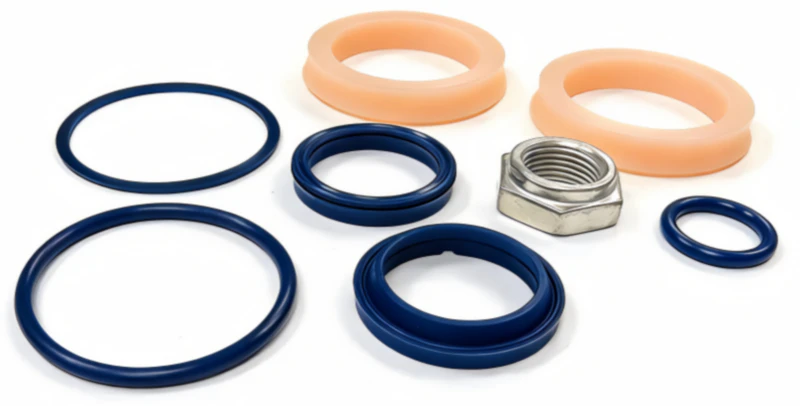
The Physics of Failure: Why Seals Break
Understanding why a seal failed is the only way to prevent it from happening again. Most failures result from a combination of the following stressors:
1. Abrasive Contamination
Microscopic particles of dust, silica, or metallic wear enter the cylinder through the rod. These act like liquid sandpaper, eroding the mirror bore (Ra 0.2µm) and rounding off the sharp sealing lips. Once the seal lip loses its “edge,” it can no longer maintain the high-pressure contact required for zero-leak performance.
2. Thermal Degradation (Heat)
If hydraulic oil temperatures exceed 80°C (180°F), seals undergo “heat hardening.” The polymer becomes brittle and loses its memory (the ability to spring back). Once a seal hardens, it cracks under the vibration of the machine, leading to sudden failure.
3. Improper Internal Finish
Budget manufacturers often rely on simple honing. However, if the surface is too rough, it shreds the seal; if it is too smooth (without the proper cross-hatch or burnishing), the seal cannot maintain a necessary lubrication film and “burns” through friction.
EP Series Seal Protection Matrix
50µm Hard Chrome
Extra-thick chrome plating prevents rod pitting, ensuring that abrasive rust never enters the seal gland to destroy the NOK matrix.
Ra 0.2µm Mirror Bores
Our CNC skiving and roller burnishing process reduces friction by 30%, lowering oil temperatures and preventing seal hardening.
Induction Quenching
Rods hardened to HRC 55 resist dings and scratches from debris, maintaining the smooth rod surface required for long-term seal health.
Dynamic QC Testing
Every cylinder is cycled at 1.5x rated load and 100°C oil to verify that the seal kits maintain their integrity in real-world heat.
Prevention: The Professional Maintenance Standard
Preventing seal failure is an economic strategy. By following a 2,000-hour technical protocol, you can extend the service life of your cylinders by up to 400%.
.webp)
Professional Maintenance Steps:
- Hydraulic Fluid Hygiene: Maintain oil to ISO 4406 16/14/11. Use high-quality 10-micron filtration to capture the abrasive particles that erode seal lips.
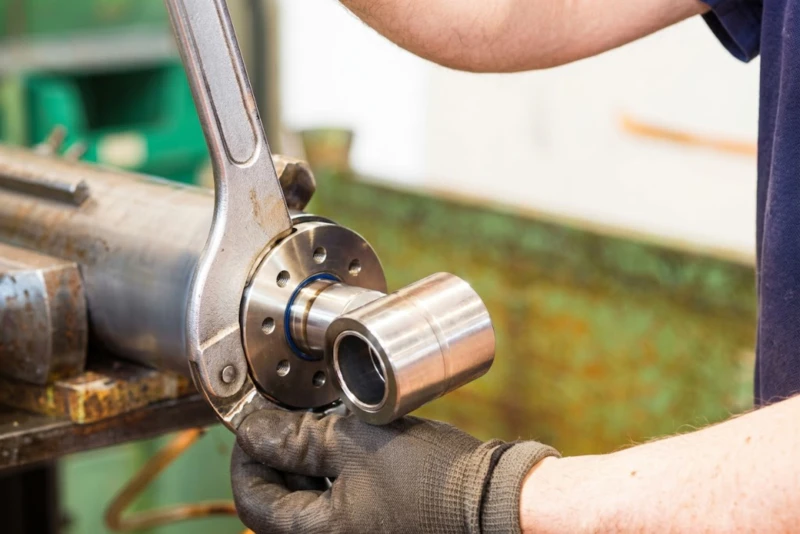
- Wiper Seal Inspection: The rod wiper is the most important seal in your system. If it is cracked or hardened by UV exposure, abrasive dirt will reach the main pressure seals within hours.
- Cooling System Check: Ensure your hydraulic oil coolers are free of debris. Keeping oil below 70°C (160°F) is the single best way to prevent seal hardening.
- Rod Surface Care: Use a non-abrasive cloth to wipe rods daily in dusty environments. If a rod ding is found, stone it smooth immediately to prevent it from shredding the seal on the next stroke.
Conclusion: Securing Your Fleet’s Hydraulic Future
In the 2026 logistics and construction industries, reliability is the only currency that matters. Hydraulic cylinder seal failure is not an inevitability—it is a manageable variable. By combining the elite engineering of the EP series at tiltcylinder.net with a rigorous preventive maintenance protocol, you can ensure that your machines remain stable, your operators remain safe, and your total cost of ownership remains the lowest in the industry.
Upgrade to Zero-Leak Performance
Stop the leaks and protect your profit. Connect with our engineering team for specialized EP series sealing solutions or high-volume OEM support.
NOK Sealing Matrix
Mirror Bore Finish
Worldwide Shipping