.webp)
Introduction
In the high-velocity landscape of modern e-commerce fulfillment, automated warehousing, and global supply chain logistics, operational throughput and structural safety are the absolute metrics of economic success. Intra-logistics networks operate on continuous twenty-four-seven processing schedules where heavy goods must be systematically lifted, precisely tilted, and securely positioned across multi-tiered racking matrixes. Within these high-density storage environments, material handling equipment must transition severe load variations seamlessly while executing rapid duty cycles. Any structural deflection, unexpected pressure loss, or linear drift in the actuation systems can precipitate catastrophic inventory collapse, severe infrastructure damage, or complete facility standstill, incurring astronomical downstream financial liabilities.
To manage these unyielding mechanical demands, modern warehousing fleets rely heavily on fluid power systems, where high-pressure linear actuators fulfill the vital role of structural muscles. Every micron of movement, from the high-reach mast extension of a cold-storage reach truck to the rapid deployment of a loading dock bridge lip, relies on the continuous power density of hydraulic systems. These specialized components are responsible for transforming raw volumetric oil flow into stable, controllable, and repeatable linear force. This engineering analysis provides a detailed evaluation of hydraulic actuation systems across modern material handling machinery, focusing on the specific tribal-physical stresses encountered in warehouse environments and the manufacturing protocols required to guarantee zero-leak reliability.
.webp)
Core Application Scenarios Breakdown
Warehouse material handling relies on synchronized, multi-axis movement to manipulate high-tonnage goods in narrow spaces. To achieve this, specialized linear actuators are engineered to perform distinct, highly concentrated physical roles.
A
Forklift Mast Lifting, Tilting, and Sideshifting Systems
Application Description: In counterbalance forklifts and high-reach trucks, the hydraulic matrix is split into three primary movement paths: mast lift cylinders, mast tilt cylinders, and integrated sideshifter cylinders. The lift cylinders, often configured as single-acting displacement rams or multi-stage telescopic columns, drive the vertical hoist velocity to lift pallets up to fifteen meters. The tilt cylinders, mounted horizontally between the truck chassis and the outer mast assembly, provide forward and backward pitch adjustment to secure the load center of gravity during transit. Concurrently, the sideshifter cylinder provides precise lateral positioning, shifting the carriage left or right to align the forks perfectly with narrow pallet entries.
Extreme Challenges: Lift and tilt mechanisms operate under extreme asymmetric side loading. As the mast extends to high elevations, any minute structural tolerance is magnified, generating massive bending moments on the piston rods. During travel across uneven warehouse floors, rapid decelerations introduce high-frequency fluid pressure surges that risk breaching seal lips. Furthermore, sideshifter cylinders operate in tight spaces exposed directly to battery soot and debris, where dry friction stick-slip behavior can disrupt micro-inch positioning accuracy.
Technical Countermeasures: To survive these localized mechanics, forklift actuators integrate low-friction phenolic wear bands along the internal guide sleeves to prevent metal-to-metal contact under heavy cross-head stresses. Additionally, tilt cylinders combine double-acting rod seals with internal structural damping elements to smoothly absorb sudden inertia changes when stopping heavy loads mid-air.
B
Aerial Work Platform Scissor Lift and Boom Actuation
Application Description: Mobile Elevating Work Platforms (MEWPs), including scissor lifts and articulating boom lifts, rely entirely on high-pressure hydraulics to raise personnel and maintenance equipment to high elevations. In scissor platforms, high-force cross-mount lift cylinders apply high initial mechanical advantage to expand the structural linkage from its lowest point. In boom-style machines, telescopic extension and luffing change cylinders manage the elevation angles and boom lengths required to position operators precisely in three-dimensional space.
Extreme Challenges: Because human lives are suspended in the platform basket, these actuators must meet strict zero-drift holding rules. Any position drift in the lift or luffing cylinder—caused by microscopic internal fluid bypass across the piston head seal—can cause sudden platform drops or changes in reach that threaten machine balance. Furthermore, boom cylinders remain extended for long periods, exposing the hard-chrome-plated piston rod to ambient environmental humidity, chemical washes, and weld splatter during site maintenance tasks.
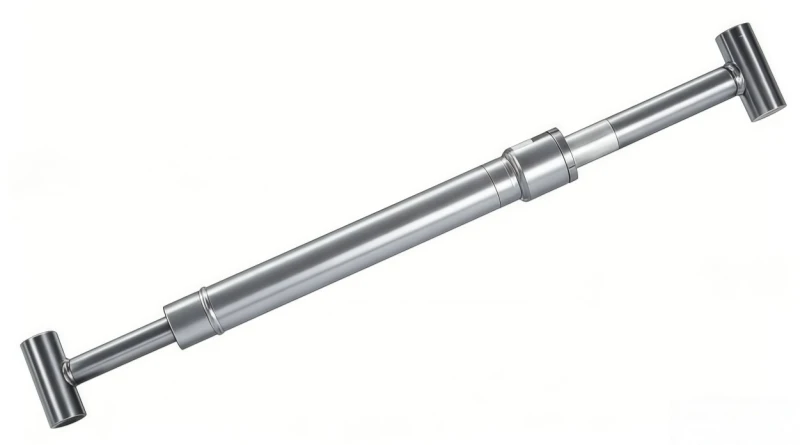
Technical Countermeasures: Failsafe operation requires that boom and scissor lift actuators feature direct-flanged, manifold-mounted pilot-operated check valves and counterbalance cartridges. These safety manifolds block fluid exit directly at the cylinder port, maintaining absolute position retention even if a main supply line suffers a sudden burst.
C
Loading Dock Levelers and Bridging Ramps
Application Description: Dock levelers and loading bays act as bridging links between warehouse floor thresholds and the open cargo beds of transport trailers. These systems utilize platform lifting cylinders to raise the main deck and lip folding cylinders to swing open or slide forward the extension lip plate, creating a continuous transit path for high-velocity forklift operations.
Extreme Challenges: Dock cylinders must withstand intense mechanical impacts. Every time a loaded forklift enters or leaves a trailer, a heavy impact load passes through the leveler framework directly into the extended hydraulic cylinders. This high-load, zero-velocity impact can generate sudden, severe hydraulic fluid pressure spikes within the cylinder barrel. Additionally, being located at external facility doors, these actuators are subject to constant thermal cycles, rain ingress, and road salt mist, creating a highly corrosive environment along the exposed rod surfaces.
Technical Countermeasures: Dock leveler cylinders are built with heavy-wall steel structures to resist cyclic pressure spikes and minimize mechanical deflection. Piston rods receive a thick, corrosion-resistant duplex electroplated hard chrome finish to ensure extended salt spray life and prevent premature pitting along the seal contact travel zones.
Core Technical Specifications and Metallurgical Architecture
Engineering high-pressure linear cylinders capable of surviving the continuous cycle counts of high-volume logistics hubs requires precision metallurgy and robust sealing matrices.
The primary structure of our specialized cylinders is forged using ST52.3 (E355) high-yield strength seamless steel tubing. This grade provides the elastic resistance needed to withstand internal working pressures up to 35 MPa without suffering dimensional expansion. The internal bore undergoes automated CNC skiving and roller burnishing to ensure an exact surface topology below Ra 0.2 micrometers. This smooth, mirror finish minimizes sliding friction coefficients, lowering localized operating temperatures and extending seal operating life. The piston rod is machined from high-tensile alloy steel, precision ground and induction hardened to a case depth of 1.5mm to 2.5mm with a surface hardness profile of HRC 55 to 60. This process establishes a rigid structural core that prevents outer case dents from impact hazards, which is then sealed beneath a 50 micrometer duplex hard chrome plating matrix to ensure superior corrosion resistance.
To prevent fluid bypass and maintain zero-drift holding stability under full capacity, our cylinders utilize an advanced, multi-component sealing architecture integrating premium Japanese NOK polyurethane polymers:
| Seal Component | Material Architecture | Primary Engineering Function |
|---|---|---|
| Primary Rod U-Cup | NOK High-Modulus Polyurethane | Maintains a liquid-tight barrier along the extending rod shaft, eliminating external weeping across active operating pressures. |
| Buffer Ring System | Filled PTFE + Elastomeric Energizer | Dampens sudden shock pressure spikes and extreme fluid impacts, protecting the primary seal lips from heat deformation. |
| Piston Sealing Matrix | NOK Compact AU Polymer Rings | Eliminates internal fluid bypass between high and low-pressure chambers, securing absolute zero-drift holding stability. |
| Double-Lip Wiper Seal | Metal-Clad Polyurethane Assembly | Scrapes away sub-micron dust particles, fiber lint, and condensation moisture films during the rod retraction cycle. |
Our Core Technical Advantages
In a marketplace often dominated by baseline commercial alternatives, our specialized cylinder lines provide logistical managers and machinery OEMs with verified product reliability. Selecting our technical manufacturing division ensures long-term component security over persistent operational risk.
Bespoke Customization
Our engineering group provides custom engineering capabilities, modifying internal strokes, mounting styles, and port parameters to match your narrow-aisle profiles or extreme sub-zero cold storage operations perfectly.
Automated Processing
We leverage multi-pass automated Submerged Arc Welding (SAW) paths to establish uniform microstructural depth across structural joints. Every component undergoes strict quality checks, including ultrasonic testing (NDT).
Optimized Lifecycle ROI
By uniting raw ST52.3 steel bodies with authentic Japanese NOK sealing elements, our cylinder systems achieve a 45 percent decrease in lifetime field maintenance and prevent unexpected equipment downtime leaks.
Smart Sensor Integration
We support advanced logistical automation by embedding absolute magnetostrictive sensors and LVDT modules inside the core cylinder structure, enabling real-time linear tracking with sub-millimeter accuracy.
Maintenance Protocol and Troubleshooting Diagnostics
Proactive preventative care is the primary variable required to sustain high fluid performance and secure continuous component uptime.
The primary contributor to component degradation within high-throughput warehousing loops is microscopic particulate contamination. Fine dust from wooden pallets, tire shred particles, and packaging fibers can bypass worn rod wipers, mixing into the hydraulic oil to create an abrasive slurry. Maintenance groups must execute scheduled fluid testing to keep oil parameters aligned with ISO 4406 16/14/11 hygiene standards. If fluid checks reveal a milky or dark color profile, it indicates water ingress or oil shear, requiring an immediate system flush and filter replacement. Concurrently, technical staff must verify torque values on structural mounting pins, clevis mounts, and cross-head bearings every 500 operating hours; asymmetrical alignment or loose tolerances will cause localized cylinder wall wear and rapid seal failure.
.webp)
Frequently Asked Questions
Can your hydraulic cylinders adapt to deep-freeze cold storage or corrosive external dock environments?
Yes, our logistical equipment actuators are engineered to operate in extreme environments. We integrate low-temperature fluorocarbon or specialized nitrile seals designed for negative 40 degrees Celsius cold storage, paired with 50 micrometer duplex chrome rod plating to prevent corrosion from outdoor moisture and salt air exposures.
What is the maximum working pressure and static proof verification pressure of your warehousing actuators?
Our standard warehousing and material handling cylinders are rated for a continuous working pressure of 35 MPa. To ensure a 4:1 bursting safety envelope, every component undergoes a mandatory static proof test up to 52.5 MPa at our quality stations before shipment.
What surface options do you provide to handle highly abrasive or hazardous logistical locations?
Beyond our standard 50 micrometer hard chrome layer, we offer advanced choices for harsh operating conditions. These include high-velocity oxy-fuel (HVOF) thermal coatings, specialized laser cladding overlays, and custom multi-layer industrial ceramic finishes to maximize surface hardness.
Can your engineering department directly manufacture cylinders using our 3D CAD files (SolidWorks/STEP)?
Yes, our engineering group works directly with native SolidWorks, STEP, IGES, and AutoCAD files. Our design team executes a complete internal drawing assessment to verify fitment and tolerance matching before launching manufacturing tracks.
What is your capacity for integrating internal position sensors for automated reach trucks or AGVs?
We provide full integration support for smart automation systems. Our facilities execute deep-hole gun drilling and modified rod heads to house magnetostrictive linear displacement sensors or internal LVDT assemblies, providing sub-millimeter position tracking data.
What is your standard minimum order quantity (MOQ) and delivery timeline for custom logistical production?
We employ flexible commercial terms, offering low MOQ options for custom engineering prototypes and developmental projects. Standard prototype production frames run 4 to 6 weeks, while large mass-production OEM batches are arranged to align with your logistical supply chain milestones.
How do your engineers protect high-lift mast cylinders from structural buckling under peak compression loads?
Every long-stroke vertical actuator undergoes structured Euler buckling modeling during our initial design checks. We calculate appropriate rod diameters, configure outer wall profiles, and expand internal guide rings to maintain total structural stability under maximum lift conditions.
What physical quality testing is performed on components before they depart your facility?
We enforce a comprehensive zero-leak validation program. Every single actuator is subjected to dynamic cycle validation, 100 percent hydrostatic pressure hold testing, stroke friction map verification, and internal bypass tests, with full documentation supplied with each delivery.
What is your baseline commercial product warranty and your response strategy for technical assistance?
All our industrial-grade cylinders include a 12-month commercial product warranty. Our technical service center remains staffed to provide diagnostic feedback, component optimization tips, and rapid replacement parts support to limit field downtime footprint.
How do you ensure that a custom tilt or lift cylinder integrates with our machine’s existing main hydraulic valves?
During our initial system design review, our technical team evaluates fluid volumetric capacities, maximum oil speeds, port thread styles, and backpressure values, confirming that the new actuator matches your pump and valve parameters perfectly.
Conclusion and Strategic Action Call
The mechanical uptime and structural safety of modern warehousing fleets depend directly on the build quality of their linear components. Investing in high-yield ST52.3 seamless steel walls, burnished micro-smooth inner finishes, and authentic Japanese sealing matrices is necessary to protect automated material handling throughput. When personnel work on elevated platforms or loaded trucks operate next to high-density racking, component integrity is paramount. If you are seeking a reliable, high-integrity hydraulic cylinder array built for continuous high-cycle operations, connect with our engineering division today. Let us transform your technical operational goals into high-performance material handling assets.