.webp)
Overview: Why Industry Standards Matter for Tilt Cylinder Safety and Performance
Industry standards for tilt cylinders exist to establish minimum safety and performance requirements that protect operators, prevent equipment failures, and ensure consistent quality across manufacturers and regions. Tilt cylinders operate under high pressure (typically 180-280 bar) with rapid cycling (often 50-100 cycles per hour on busy distribution center forklifts), subjecting components to extreme stress. Without rigorous standards governing material specifications, design safety factors, manufacturing precision, and performance testing, cylinder failures could create catastrophic safety hazards.
Standards compliance also drives equipment compatibility and interchangeability. When all manufacturers design cylinders to meet ISO 6162 dimensional requirements, customers can source replacement cylinders from multiple suppliers, enabling competitive pricing while maintaining performance consistency. Standards eliminate the risk that a supplier’s custom design creates incompatibilities with existing hydraulic systems, making maintenance and supply chain management more efficient.
Regulatory compliance—particularly OSHA requirements in the United States—creates legal obligations for fleet owners and operators. Failure to maintain equipment meeting applicable safety standards can result in fines, liability exposure, and lost operator certifications. Understanding which standards apply to your specific equipment and operations ensures compliance and protects your organization from regulatory risk.
The standards ecosystem governing tilt cylinders includes international standards (ISO), industrial fluid power standards (NFPA), regional safety regulations (OSHA in North America), and specialized standards addressing specific applications or hazards. Navigating this complex landscape requires understanding how these standards interact and which requirements apply to your specific circumstances.
ISO 6162: The International Standard for Hydraulic Cylinder Specifications
ISO 6162 is the foundational international standard governing hydraulic fluid power cylinders. Established and maintained by the International Organization for Standardization, ISO 6162 defines dimensional requirements, pressure ratings, performance criteria, and testing procedures applicable to all hydraulic cylinders including those used in tilt systems. Manufacturers worldwide reference ISO 6162 as the baseline specification for cylinder design and manufacturing.
Key Dimensional Requirements: ISO 6162 establishes standard bore diameters (measured in millimeters) available in a geometric series: 10, 12, 16, 20, 25, 32, 40, 50, 63, 80, 100, 125, 160, 200, 250, 320, 400, 500mm. This standardization enables manufacturers to produce cylinder components in high volumes, reducing costs while ensuring compatibility across equipment types. Standard rod diameters for each bore are specified at precise ratios (typically 0.7× bore diameter), ensuring predictable force characteristics and seal performance across all products meeting the standard.
Pressure Ratings and Safety Factors: ISO 6162 designates pressure classifications: 210 bar (nominal), 280 bar, and 350 bar are common pressure ratings. Each pressure class assumes a specific design safety factor—typically 4:1 for normal industrial applications, meaning a cylinder rated for 210 bar is designed and tested to withstand 840 bar before failure occurs. Tilt cylinders in standard forklifts typically operate at 210 bar system pressure, with cylinders rated for 280 bar providing margin for pressure spikes and providing compatibility with higher-pressure systems used in some specialized equipment.
Port and Cavity Specifications: ISO 6162 defines standard cavity sizes for proportional directional control valves (NG10, NG16, NG25 cavities) and standard pressure port configurations (SAE, ISO ported flanges with specified bolt circles and thread sizes). These standardized connections enable proportional valve and cylinder interchangeability, allowing replacement with products from multiple manufacturers while maintaining system compatibility.
Performance Testing Requirements: ISO 6162 specifies mandatory pressure testing protocols: cylinders must withstand rated working pressure without external leakage, maintain pressure hold within specified limits (typically 1% per minute loss), and achieve specified cycle speeds and responsiveness. Test procedures establish minimum cleanliness requirements (ISO 4406 16/14/11 cleanliness class or better) ensuring that assembled cylinders perform reliably in field hydraulic systems.
NFPA Standards: Industrial Fluid Power Component Requirements
The National Fluid Power Association (NFPA) publishes standards addressing fluid power systems and components, including detailed requirements for hydraulic cylinders used in industrial applications. NFPA standards complement and in some cases supersede ISO standards by addressing North American manufacturing practices, testing methodologies, and application-specific requirements.
NFPA T2.19.1R: Remanufactured Hydraulic Cylinders Standard: This standard specifically addresses remanufactured cylinders, establishing requirements for core acceptance testing, dimensional restoration, component replacement, cleanliness verification, and performance testing. NFPA T2.19.1R ensures that remanufactured cylinders meet performance standards equivalent to new manufacturing by requiring documented inspection records, specified repair procedures, and comprehensive pressure testing before release.
NFPA T3.22.1R: Hydraulic Cylinder Installation, Operation, and Maintenance Standard: This standard provides detailed guidance for proper cylinder installation, system integration, operational procedures, and maintenance schedules. NFPA T3.22.1R specifies that installation must account for cylinder alignment (angular misalignment exceeding 2 degrees creates excessive side loads and accelerates seal wear), mounting rigidity (cylinders must be mounted to prevent bending loads from lateral forces), and proper pressure line sizing (flow velocities exceeding 5 m/s in inlet lines cause cavitation and component damage).
NFPA Cleanliness Standards (ISO 4406): NFPA standards reference ISO 4406 cleanliness classification, typically requiring 17/15/12 or better cleanliness for industrial hydraulic systems. This classification means fewer than 10 particles larger than 4 micrometers per milliliter of fluid—a purity level essential for maintaining seal performance and preventing abrasive damage to precision internal components. Remanufactured cylinders must undergo flushing and cleanliness verification to achieve these standards.
OSHA Requirements for Forklift Equipment Safety and Maintenance
In the United States, OSHA (Occupational Safety and Health Administration) regulations govern forklift safety, including requirements for tilt cylinder maintenance and inspection. While OSHA standards do not specify detailed technical cylinder requirements, they establish broader safety obligations that directly impact tilt cylinder management.
OSHA 1910.178(q): Forklift Operation and Maintenance Requirements: This regulation requires employers to ensure that forklifts are maintained in safe operating condition and inspected regularly for mechanical damage, deterioration, and defects. Tilt cylinders exhibiting external leakage, reduced tilt speed, jerky proportional control response, or visible damage must be repaired or replaced before the equipment returns to service. Equipment with safety defects must be taken out of service immediately and tagged to prevent accidental operation.
Pre-Operation Inspection Requirements: OSHA requires operators to conduct pre-operation inspections before each shift, checking for visible damage, leaks, and operational problems. Operators must report defects to supervisors and decline to operate equipment with identified safety issues. Tilt cylinder leaks observed during pre-operation inspection typically necessitate equipment removal from service pending repair or component replacement.
Maintenance Records and Documentation: OSHA standards require employers to maintain maintenance records documenting equipment inspections, repairs, and modifications. These records protect employers by demonstrating compliance with maintenance obligations and establishing a baseline for equipment condition assessment. Well-maintained maintenance records also facilitate trend analysis—identifying patterns of recurring tilt cylinder problems that might indicate systemic issues requiring design or system-level corrections.
Operator Training and Certification: OSHA requires that forklift operators be trained and certified, with training covering safe equipment operation, load handling, hazard recognition, and pre-operation inspection procedures. Operator training must include recognition of tilt system problems: if tilt response becomes jerky or uncontrollable, operators must immediately stop operations and notify supervisors, preventing accidents from hydraulic system failures.
ISO 3471 and Rollover Protective Structures: Tilt Cylinder Design Implications
ISO 3471 establishes requirements for rollover protective structures (ROPS) on forklifts, defining load testing and design criteria that prevent operator injury if equipment overturns. While ISO 3471 addresses protective structure design rather than tilt cylinder specifications directly, the standard influences tilt cylinder requirements by establishing maximum tilt angles and load cases that cylinders must support without failure.
ISO 3471 testing requires that forklifts withstand rollover loads equivalent to the equipment’s maximum load (for a 2,500 kg capacity forklift, this means withstanding forces equivalent to a 2,500 kg weight impacting the mast during rollover). Tilt cylinders must remain structurally sound and maintain pressure containment under these extreme load cases, preventing cylinder rupture that could spray pressurized hydraulic fluid onto operators. Cylinder design engineers account for these ROPS-related load cases when establishing bore sizes and structural reinforcement requirements.
For users of older forklifts manufactured before ROPS requirements became standard, retrofitting modern ROPS devices may require verification that existing tilt cylinders remain safe under the increased structural loads imposed by protective structures. In some cases, ROPS installation necessitates tilt cylinder replacement with models designed for higher load ratings.
ISO 4406 Cleanliness Standards: Critical for Tilt Cylinder Reliability
ISO 4406 establishes hydraulic fluid cleanliness classification using particle counting methodology. The standard expresses cleanliness as three numbers representing particle counts larger than 4, 6, and 14 micrometers per milliliter. A 17/15/12 classification means fewer than 1,280 particles larger than 4 micrometers, fewer than 320 particles larger than 6 micrometers, and fewer than 20 particles larger than 14 micrometers per milliliter of fluid.
Relationship to Tilt Cylinder Performance: Seal life and performance directly correlate with hydraulic fluid cleanliness. Particles larger than 10 micrometers can lodge between piston rings and cylinder bore, creating microscopic scratches (scoring) that progressively enlarge sealing surfaces and accelerate internal leakage. Particles larger than 20 micrometers can block proportional valve spools, creating jerky control response and stuck valve conditions. Maintaining ISO 17/15/12 cleanliness (or better) prevents these failure modes and enables full tilt cylinder service life.
Achieving Cleanliness Standards: New hydraulic systems typically achieve 17/15/12 cleanliness through flushing procedures performed before equipment delivery. Ongoing cleanliness is maintained through regular filter changes (typically every 500-1,000 operating hours), fluid analysis programs that monitor particle concentrations, and disciplined fluid handling practices (preventing water ingress, dirt contamination, and cross-contamination between systems). Systems operating at higher cleanliness levels (16/14/11 or better) achieve longer component life and more reliable performance.
CE Marking and Directives: European Union Compliance Requirements
In the European Union, forklifts and other industrial equipment must comply with the Machinery Directive (2006/42/EC), requiring CE marking and comprehensive safety documentation. The Machinery Directive mandates risk assessment, hazard identification, and implementation of controls to reduce risks to acceptable levels. For tilt cylinders, this means manufacturers must analyze failure modes, establish design safety factors, perform testing to verify safe operation, and document all decisions in technical files.
EC Declaration of Conformity: Manufacturers of tilt cylinders and forklift systems must issue an EC Declaration of Conformity certifying that equipment meets all applicable directives. This declaration requires documentation that the equipment meets relevant harmonized standards (typically ISO 6162 for cylinders, ISO 3691-4 for forklift stability and safety) and that risk assessment was completed. Without valid CE marking and conformity documentation, forklifts cannot be legally sold or operated in EU member states.
Pressure Equipment Directive (PED): Tilt cylinders operating above specified pressure/volume combinations fall under PED (Directive 2014/68/EU), requiring designation of a Notified Body (independent third-party certification organization) to verify design safety and manufacturing quality. PED compliance involves documentation of design calculations, material certifications, pressure testing records, and periodic audits by Notified Bodies, ensuring that cylinders meet stringent European safety requirements.
SAE Standards for Porting and Cavity Configurations
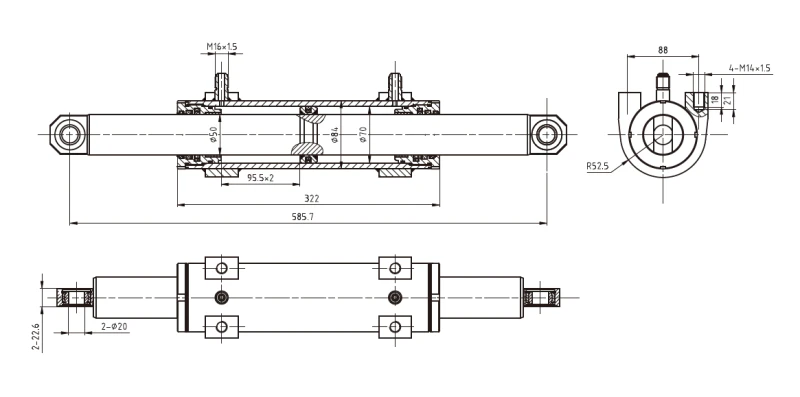
SAE (Society of Automotive Engineers) standards define cavity configurations and porting standards for proportional directional control valves and cylinder connections. SAE J1453 establishes dimensional requirements for SAE-ported cylinders and valves, enabling interchangeability among manufacturers. Many forklift manufacturers—particularly those in North America—use SAE cavity sizing and porting standards, making SAE compliance essential for achieving compatibility with proportional valve systems.
SAE porting configurations (SAE J518 Code 61, Code 62) define pressure port thread sizes and bolt circle diameters for flange-mounted cylinders. SAE Code 61 (1-inch NPTF threads on 2.00-inch bolt circle) is commonly used on small cylinders, while SAE Code 62 (1.5-inch NPTF on 3.00-inch bolt circle) suits larger cylinders. Specifying correct SAE porting ensures that replacement cylinders connect properly to existing proportional valve systems without requiring adapter plates or system modifications.
DNV, Lloyd’s Register, and Third-Party Certification for Specialized Applications
For specialized applications (marine environments, offshore equipment, hazardous classified locations), third-party certification organizations like DNV (Det Norske Veritas) and Lloyd’s Register provide independent verification that tilt cylinders meet additional requirements for corrosion resistance, explosive atmosphere safety, or extreme environmental conditions. These certifications require documented design reviews, material certifications, manufacturing audit procedures, and periodic re-audits ensuring ongoing compliance.
Organizations operating forklifts in hazardous areas (chemical plants, grain elevators, fuel distribution facilities) must verify that hydraulic equipment meets applicable classifications. Equipment designated for Class II hazardous locations (combustible dust environments) may require specially sealed cylinders preventing dust ingress and static electricity generation. Third-party certification provides documentation necessary to demonstrate regulatory compliance in these specialized environments.
Implementing Standards Compliance in Your Fleet Operations
Step 1: Document Equipment Specifications and Applicable Standards: Identify the forklift models and tilt cylinder types in your fleet. Research which standards apply to your equipment (ISO 6162 for all forklifts, NFPA standards if equipment is manufactured or operated in North America, EU directives if equipment operates in European Union, third-party certifications if operating in hazardous areas). Document the year of manufacture and applicable regulations at the time of manufacturing—standards have evolved, and older equipment may not meet current standards.
Step 2: Establish Maintenance and Inspection Procedures Aligned with Standards: Develop maintenance procedures requiring pre-operation inspections for visible leaks, damage, and operational defects. Establish cylinder replacement criteria aligned with NFPA guidance (typically replacement required if external leakage exceeds slight weeping, if tilt speed drops below 70% of specification, or if proportional control response becomes jerky). Maintain detailed maintenance records documenting all inspections, repairs, and component replacements.
Step 3: Verify Replacement Component Compliance: When replacing tilt cylinders, specify components meeting applicable standards. Confirm that replacement cylinders meet ISO 6162 specifications matching your equipment’s pressure ratings and dimensional requirements. Verify that remanufactured cylinders include documentation showing compliance with NFPA T2.19.1R standards. For EU-operated equipment, confirm CE marking and EC Declaration of Conformity documentation.
Step 4: Implement Fluid Management Programs: Establish hydraulic fluid analysis programs measuring particle counts to ISO 4406 standards. Maintain fluid cleanliness at 17/15/12 or better through regular filter changes and proper fluid handling. Replace fluid annually or at maintenance intervals specified by equipment manufacturers. Conduct fluid analysis annually or quarterly on high-utilization equipment, using particle counts to identify developing problems early.
Step 5: Operator Training and Hazard Communication: Ensure operators receive training addressing tilt system hazards, proper pre-operation inspection procedures, and requirements to report defects. Communicate the hazards of pressurized hydraulic systems, proper lockout/tagout procedures, and requirements to prevent accidental pressure release. Document training completion and maintain training records verifying OSHA compliance.
Conclusion: Standards as Protection and Risk Management
Industry standards governing tilt cylinders represent decades of accumulated engineering knowledge and operational experience. ISO 6162, NFPA standards, OSHA requirements, EU directives, and specialized certifications work together to establish minimum safety and performance requirements that protect operators and ensure equipment reliability. Understanding which standards apply to your specific equipment and operations enables you to maintain compliance, reduce accident risk, and demonstrate due diligence in safety management.
Standards compliance is not merely a regulatory obligation—it represents best practices derived from industry experience. Equipment and maintenance procedures aligned with these standards experience fewer failures, longer component life, and more reliable performance. For comprehensive guidance on standards compliance tailored to your specific fleet composition and operating jurisdiction, contact our technical team who can review your equipment specifications and recommend compliance procedures. Our resource library includes detailed standards documentation and compliance guides for all major equipment types and jurisdictions. For additional information on pressure testing standards and verification procedures, consult our comprehensive industrial standards reference materials.