.webp)
A 2026 Technical Compendium on Columnar Buckling Physics, High-Tonnage Load Retention, and Metallurgical Rigidity in Crawler Crane Actuation.
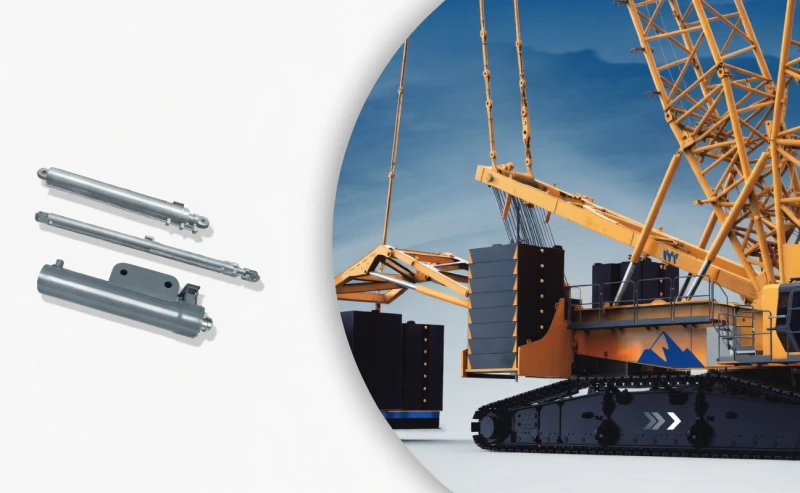
In the hierarchy of mechanical leverage, the lattice-boom crawler crane represents the absolute summit. As these machines scale to lift loads exceeding 3,000 tons, the luffing cylinder transitions from a standard actuator into a safety-critical structural spine.
The luffing cylinder (mast angle cylinder) is responsible for the precise positioning of the boom. Unlike telescoping cranes, where forces are distributed through multiple boom sections, a lattice crane concentrates its massive moment-loads directly onto the luffing hydraulics. In the operational landscape of 2026, where modular nuclear reactors and mega-wind turbines are the standard units of lift, the tolerance for cylinder deflection has effectively reached zero.
At tiltcylinder.net, our EP series is engineered specifically for these high-moment environments. We recognize that stability is a function of three integrated variables: Columnar Rigidity, Zero-Drift Sealing, and Thermal Consistency. This white-paper provides a granular analysis of the mechanical stressors affecting luffing cylinders, the metallurgical solutions required to prevent buckling, and the economic necessity of high-redundancy hydraulics in modern infrastructure. For heavy-lift engineers and EPC contractors, this is the definitive guide to mast-angle integrity.
Columnar Buckling: The Hidden Limit of Lifting
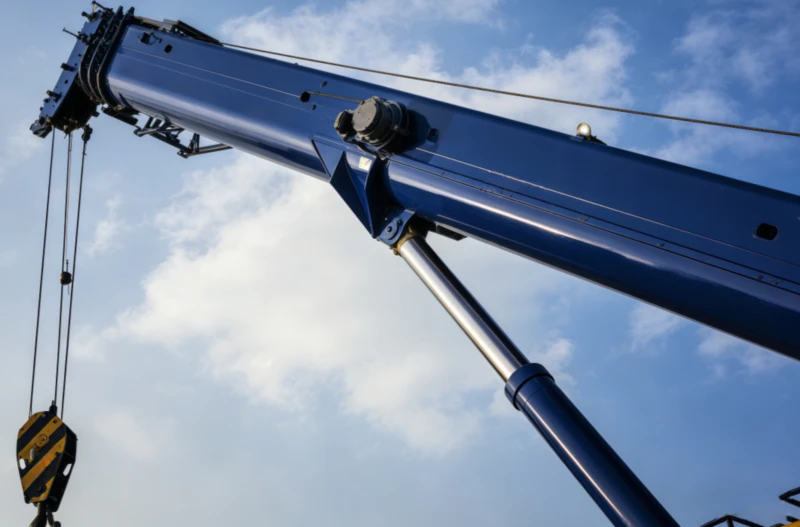
The primary mechanical threat to a crane luffing cylinder is not internal pressure, but Columnar Buckling. When a lattice boom is at a low angle, the luffing cylinder is subjected to massive axial compression. If the cylinder rod is not designed with a sufficient Moment of Inertia, it will undergo micro-radial deflection.
The 2026 Engineering Standard: In 2026, we utilize the Euler Buckling Load (Pcr) to define safety envelopes. Even a 5-micron bow in a 400mm rod creates asymmetrical loading on the internal guide rings, leading to rapid seal failure and structural collapse.
To eliminate this risk, the EP series utilizes high-strength ST52.3 (E355) seamless steel for the barrel and induction-hardened CK45 rods. By maximizing the rod-to-bore ratio and ensuring 100 percent concentricity during our CNC Skiving process, we increase the critical buckling load by 25 percent compared to standard aftermarket alternatives.
The Science of Neutral: Achieving Zero-Drift Hold
In lattice boom operations, long-duration static holds are common (e.g., during the precision placement of a wind turbine nacelle). Any internal fluid bypass in the luffing cylinder results in mast drift. A drift of just 5 millimeters at the cylinder translates to a 1-meter drop at the boom tip—a movement that can be fatal in nuclear or urban construction.
The Synergy of Finishes: We achieve Zero-Drift through the integration of Japanese NOK multi-lip seals and our proprietary Ra 0.2 micron mirror-burnished bores. Traditional honing leaves microscopic peaks that shred seals during high-pressure holds. Our roller burnishing process cold-works the bore wall, creating a flat plateau topography. This allows the NOK seal to maintain a vacuum-tight contact, ensuring that the crawler crane’s mast stays locked at the exact programmed angle without the need for constant hydraulic adjustment.
The EP Series Lattice-Lift Foundation
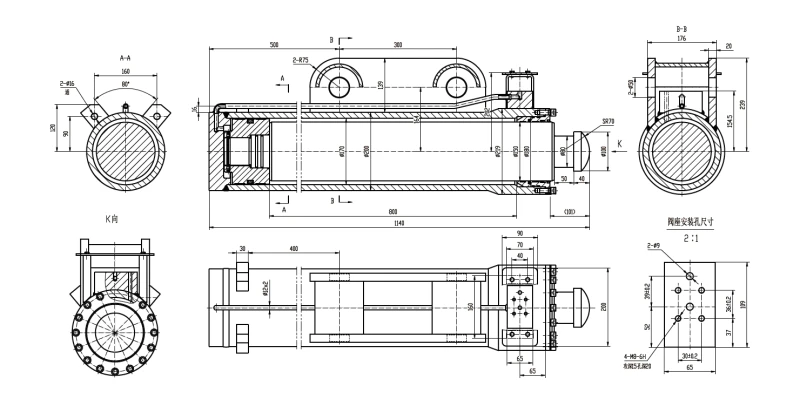
35MPa Redundancy
Engineered from high-yield ST52.3 seamless tubing to withstand massive pressure surges during dynamic wind-gust events.
Zero-Drift Matrix
Utilizing Japanese NOK multi-lip polymers to eliminate internal fluid bypass, ensuring mast stability for days, not hours.
Induction Hardened
Rods hardened to HRC 55-60 resist the abrasive silica dust of construction sites, preventing the rod-pitting that shatters seals.
Ra 0.2 micron Polish
Mirror-bore finishing reduces internal heat generation by 30 percent, preserving oil viscosity and preventing seal hardening.
Safety Redundancy: Integrated Load-Holding Valves
In high-tonnage lifting, a hose failure cannot be a catastrophic event. In 2026, global standards mandate that all crawler crane luffing cylinders must feature direct-mounted safety manifolds.
The EPYY Safety Lock: Our cylinders feature Manifold-Integrated Counterbalance Valves fused directly to the cylinder base via robotic SAW welding. These valves act as a physical deadbolt. They only open when the operator provides a specific pilot pressure, ensuring that even if a main hydraulic line is severed by falling debris, the boom remains mechanically locked in place. By eliminating the need for external plumbing between the valve and the cylinder, we remove the primary point of failure in heavy-duty hydraulics.
Manufacturing Silence: Robotic Fusion and NDT Testing
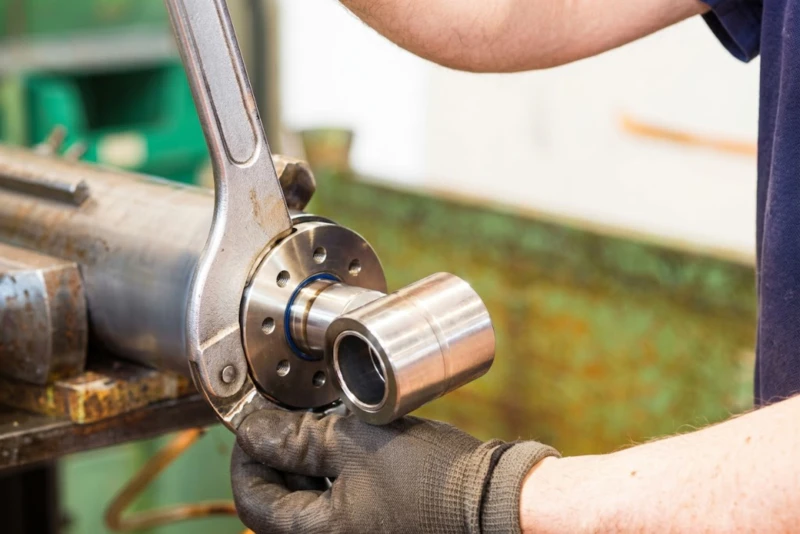
When human lives are suspended beneath a lattice boom, manufacturing error is unacceptable. Our production facility is a benchmark for Industrial 4.0 Hydraulic Fabrication. Every critical joint on an EP series cylinder is performed by multi-pass robotic Submerged Arc Welding (SAW). This provides deeper penetration and 100 percent repeatability compared to manual welding.
Verification Protocol: After welding, every cylinder undergoes Ultrasonic Non-Destructive Testing (NDT). This ensures zero subsurface porosity in the trunnion and flange mounts—the high-stress zones where fatigue cracks typically begin. This automated rigor is why the 10,000th EP series cylinder performs exactly like the first, a requirement for global OEM partners and the world’s largest crane rental cooperatives.
.webp)
Economic Intelligence: ROI of Mast Stability
In the heavy rental and EPC sectors, a crawler crane’s profitability is measured by its availability. A luffing cylinder failure can ground a 600-ton crane for weeks, costing the owner upwards of 75,000 USD in lost revenue and mobilization fees. By investing in the EP series, fleet managers typically achieve a 50 percent reduction in unplanned maintenance.
- Reduced Oil Degradation: Mirror-bore finishes run 15 degrees Celsius cooler, doubling the life of hydraulic fluid via reduced oxidation.
- Seal Longevity: Eliminating stick-slip chattering prevents the brittle-hardening of NOK seal lips, extending seal life by 3x.
- Energy Efficiency: Laminar flow systems consume less fuel; noise and vibration are literally the sound of energy being bled off as heat.
- Resale Value: Machines equipped with verified EPYY hydraulics maintain higher valuation in the secondary rental market.
Conclusion: The Hydraulic Foundation of Heavy Progress
As global infrastructure projects reach new heights and weights in 2026, the reliance on high-tonnage crawler cranes has become absolute. The luffing cylinder remains the critical, physical link in the chain of stability. At tiltcylinder.net, we combine world-class ST52.3 metallurgy, Japanese sealing excellence, and rigorous automation to provide the actuators that ensure every mega-lift is performed with absolute confidence. The EP series is more than a product; it is the structural backbone of progress.
Stabilize Your Heavy Fleet Today
Eliminate mast drift and columnar buckling. Connect with our engineering team for custom EP series luffing solutions or high-volume OEM support.
Heavy-Lift Stability
100 percent NDT Tested
Worldwide Shipping