.webp)
Overview: Understanding Equipment Retrofitting with Tilt Cylinders
Equipment retrofitting represents a strategic approach to extending machinery lifespan, improving operational efficiency, and enhancing workplace safety without requiring complete equipment replacement. Tilt cylinders—precision hydraulic actuators designed to manage angular orientation and load positioning—have become essential components in retrofit projects across agricultural, construction, material handling, and manufacturing sectors. The retrofitting process involves systematic evaluation of existing equipment, assessment of hydraulic system compatibility, precise installation of tilt cylinder assemblies, and comprehensive performance validation. Unlike new equipment deployment, retrofit installations demand careful engineering coordination, existing system integration, and methodical commissioning protocols to achieve optimal results. The financial advantage of retrofitting becomes apparent when considering that new equipment can represent capital expenditures of $50,000 to $500,000+, whereas strategic component upgrades often cost $8,000 to $45,000, delivering productivity improvements comparable to new equipment acquisitions.
Evaluating Retrofit Candidacy: When to Retrofit Existing Equipment
Not all equipment represents suitable retrofit candidates. Determining retrofitting feasibility requires systematic evaluation across multiple technical, economic, and operational criteria. First, assess the mechanical foundation’s structural integrity—existing frame, mounting points, and load-bearing capacity must demonstrate adequate strength to accommodate additional hydraulic forces generated by new tilt cylinder installations. Conduct ultrasonic thickness measurements and visual inspections of welded joints, particularly around potential cylinder mounting locations. Second, evaluate the current hydraulic system’s capacity and condition. Existing pumps must deliver sufficient flow (measured in gallons per minute, or GPM) and pressure (in pounds per square inch, or PSI) to operate new tilt cylinders during simultaneous equipment functions. A forklift with a 25 GPM, 2500 PSI hydraulic system adding a tilt cylinder function requires approximately 8-12 additional GPM at system pressure—feasible on most systems, but marginal systems may require pump replacement costing $3,500 to $8,500. Third, evaluate operator control interfaces and electrical systems. Modern control systems may require PLC (Programmable Logic Controller) integration, valve sequencing logic, and safety interlocks. Legacy equipment often relies on manual lever controls compatible with proportional valve technology, facilitating modular upgrades. Fourth, conduct a cost-benefit analysis comparing retrofit investment against equipment replacement value. Equipment generating $75,000-$150,000 annual revenue justifies retrofit investments up to 25-30% of replacement cost. A $12,000 retrofit on equipment worth $40,000 represents reasonable financial strategy; a $12,000 retrofit on equipment worth $8,000 suggests replacement consideration. Fifth, verify manufacturing support and spare parts availability. Established manufacturers like those producing ISO 6162-compliant cylinders ensure 15-20 year parts supply, while obsolete equipment or orphaned product lines may face sourcing challenges.
Hydraulic System Compatibility Assessment
Successful tilt cylinder retrofitting depends entirely on hydraulic system compatibility with new components. Begin compatibility assessment by documenting existing system parameters: identify the hydraulic pump displacement (cc/rev), maximum operating pressure (PSI rating), actual flow output (measured GPM), fluid volume (reservoir capacity in gallons), and fluid specification (ISO VG viscosity grade, typically VG 46 for most industrial systems). Measure actual system pressure under load using an accurate pressure gauge; nominal ratings often differ from real-world operating conditions by 10-20%. Photograph or document all hydraulic schematic diagrams before beginning work—these become critical troubleshooting references during commissioning. Next, verify existing hydraulic fluid compatibility with new cylinder seals and materials. Most modern tilt cylinders employ Viton elastomer seals compatible with ISO VG 46 or ISO VG 68 hydraulic fluids. Legacy equipment sometimes utilized vegetable-based or fire-resistant fluids (chlorinated paraffin or phosphate esters) incompatible with standard seals. Perform fluid analysis on existing system to identify fluid type, viscosity, and contamination levels. Fluid cleanliness typically ranges from ISO 4406 cleanliness codes 16/14/11 (marginal) to 18/16/13 (optimal). Retrofit installations generally tolerate ISO 16/14/11 cleanliness if supplementary filtration is added during commissioning. Evaluate the existing filtration system capacity—if current filters handle 10 GPM flow and new tilt cylinders require 12 GPM total circuit flow, filtration capacity has become limiting. Calculate total system flow demand by adding pump output to regeneration flows (return circuit flow), then verify filtration element capacity exceeds this sum by 20%. If inadequate, specify 10-micron filter upgrades costing $1,200 to $3,500. Assess electrical power availability for proportional valve actuation and pressure monitoring sensors. Most retrofit installations require 24 VDC control power and 110-240 VAC auxiliary power for PLC systems. Verify that existing vehicle or equipment electrical systems can deliver these power supplies without affecting primary equipment operation.
Mechanical Integration and Mounting Design
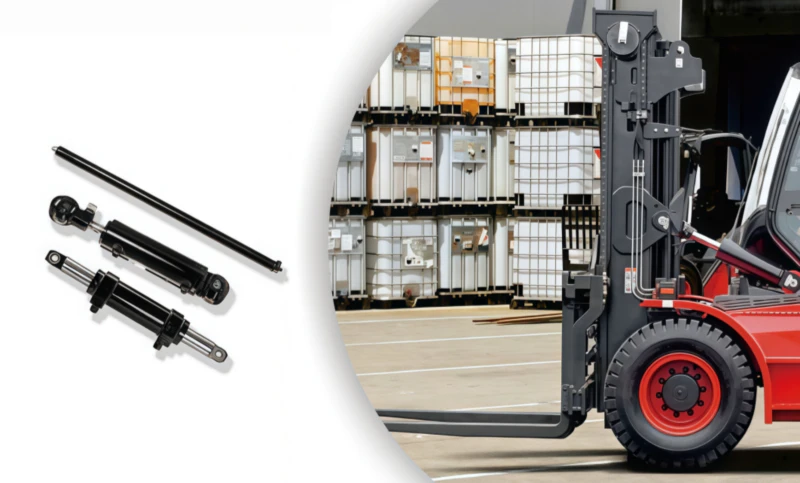
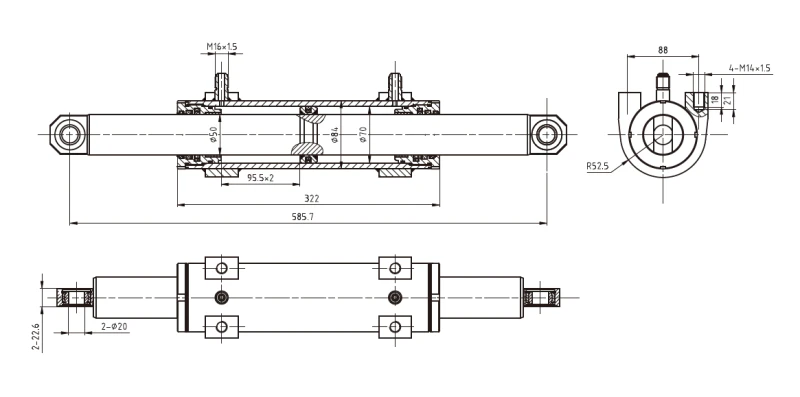
Retrofitting tilt cylinders requires precise mechanical integration addressing load path analysis, mounting point design, and structural reinforcement. Begin by analyzing the attachment structure—identify where equipment loads transfer through the frame, and confirm that new cylinder mounting points align with primary load paths. Finite Element Analysis (FEA) modeling, though not always necessary for smaller equipment, provides confidence that frame stress concentrations remain within material yield limits (typically 25,000-30,000 PSI for mild steel structural members). For most retrofits, especially agricultural and material handling applications, manual stress analysis using classical mechanics proves adequate: calculate the moment arm (distance from frame neutral axis to mounting point), divide bending moment by section modulus to determine bending stress, then confirm combined stresses (bending plus direct load stress) remain below 50% of material yield strength. Consulting with a structural engineer costs $2,500-$6,000 but provides essential documentation for insurance and regulatory compliance. Mount cylinders using Grade 8 or Grade 10.9 bolts (minimum strength 150,000 PSI tensile) specified per ISO 4014 standards, with bolt torque calculated at 70% of ultimate tensile strength per bolt area. A 0.75-inch diameter Grade 8 bolt typically requires 250-280 lb-ft torque, verified using calibrated torque wrenches not impact tools. Design mounts to isolate vibration using elastomer bushings (natural rubber or synthetic, rated 60-70 Shore A hardness) preventing transmission of hydraulic oscillations into frame structures. This simple measure, costing $400-$800, often prevents fatigue cracking that would otherwise develop within 2-3 years of operation. Position cylinders to maintain 15-25 degree optimal operating angle during full extension—angles greater than 45 degrees introduce rod bending loads and accelerate seal wear. Verify accessibility for routine maintenance including seal inspection, accumulator precharge verification (if accumulators are present), and valve cleaning—maintenance accessibility costs nothing in design time but prevents $5,000+ emergency repairs caused by inaccessible or seized components.
Hydraulic Line Routing and Protection
Hydraulic line routing represents a critical retrofitting phase often overlooked during planning. High-pressure hoses carrying tilt cylinder flow (typically 2000-2500 PSI) demand careful routing to prevent abrasion, heat damage, and collision-induced rupture. Route hoses away from sharp frame edges by minimum 2-inch clearance, protecting lines with split hose sleeves (reinforced nylon or PVC, cost $0.50-$1.50 per linear foot) where unavoidable clearances occur. Support hoses every 24-36 inches using cushioned clamps (elastomer-lined aluminum or stainless steel, cost $15-$45 per clamp) preventing vibration-induced fatigue failures. Maintain minimum bend radius specifications—typically 3x hose outer diameter for high-pressure hose, though specific specifications depend on hose construction. A 0.5-inch diameter hose with 1-inch minimum bend radius permits installation in confined spaces, whereas 0.75-inch diameter hose requires 2.25-inch bend radius, affecting routing constraints. Organize hoses into bundles using Velcro cable ties (reusable, cost $1-$2 each) rather than zip ties (non-reusable, risk cutting into hose insulation). Label all hoses with directional flow arrows and pressure ratings using adhesive-backed labels, facilitating rapid troubleshooting and future maintenance. Plan return-line routing to permit unrestricted flow back to reservoir—return line pressure must stay below 25-30 PSI to prevent seal degradation. Position return lines above reservoir fluid level when possible to prevent siphoning effects during pressure relief cycles. If return lines must be submerged in reservoir fluid, install anti-siphon check valves (cost $80-$150 each) preventing reservoir emptying during emergency pressure release. Install inline pressure relief valves (adjustable 500-2500 PSI, cost $300-$800 each) on supply lines to new tilt cylinders, protecting against accidental over-pressure during commissioning and field adjustments.
Valve Selection and Control System Integration
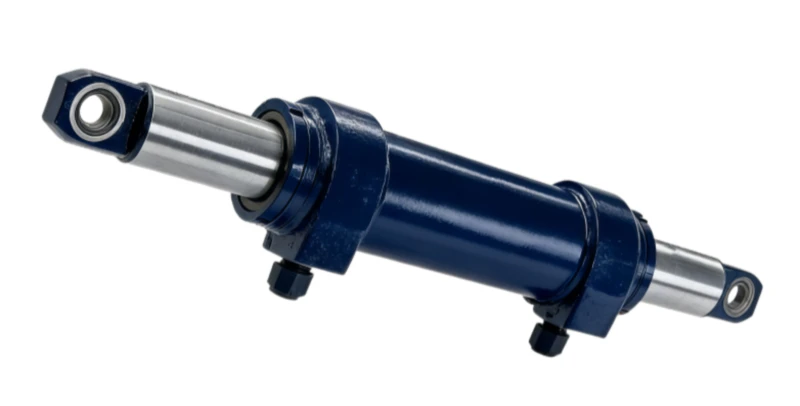
Tilt cylinder operation demands proportional or directional control valves matched to system pressure, flow, and response characteristics. For retrofit applications, proportional directional control valves (P-D-T configuration: pump, down-stream, and tank ports) costing $2,500-$5,500 provide superior modulation compared to solenoid-operated directional valves, enabling smooth operator control and operator safety. Proportional valves integrate electronic command signals (0-10 VDC analog or CAN bus digital) with mechanical spool actuation, delivering flow rates proportional to operator input. This eliminates the jerky on-off behavior of solenoid valves, reducing operator fatigue and improving load positioning accuracy to ±1-inch precision or better. Select valve body cavity sizes matching hose port connections—typically SAE NG6 (cavity size 6, 0.75-inch ports, 40 LPM rated flow) for most tilt cylinder retrofits. Specify valve opening pressure (pilot pressure required for spool actuation) at 30-50 PSI for smooth response. Integrate proportional valve control through PLC systems capable of reading operator joystick input, scaling commands to 0-10 VDC proportional valve command signals, and implementing safety interlocks preventing unintended equipment motion. Install pressure transducers (0-3500 PSI range, 4-20 mA output, cost $400-$800 each) upstream and downstream of proportional valves, enabling real-time pressure monitoring and proportional valve fault diagnostics. Establish interlock logic preventing tilt cylinder operation unless primary equipment functions (boom lowering, attachment engagement) have been confirmed completed. This prevents catastrophic failures where improper operational sequencing causes uncontrolled load drop or attachment collision. Test and document all interlock sequences in written procedures before equipment release to production. Install manually-operated proportional valve spools (backup mechanical controls, cost $1,800-$3,200) permitting operator control of tilt cylinders if electronic systems fail, ensuring equipment can return to safe parking positions without external assistance.
Installation Procedures and Commissioning Protocol
Professional retrofit installation follows systematic procedures minimizing equipment downtime and ensuring safety compliance. Schedule retrofitting during planned maintenance windows, ideally during low-production periods when equipment shutdown impact is minimized. Drain hydraulic fluid into certified fluid recycling containers before beginning installation—improper fluid disposal violates EPA regulations (40 CFR Parts 261-266) and creates environmental liability. Photograph existing equipment configuration for documentation and troubleshooting reference. Remove attachment points, mounting brackets, or equipment structures that would interfere with new cylinder installation. Clean mounting surfaces using compressed air and lint-free cloths—cleanliness is essential because any debris (rust particles, paint chips, seal fragments) will migrate through hydraulic lines, potentially causing proportional valve stiction and equipment failure. Install tilt cylinders on prepared mounting surfaces using Grade 8 bolts torqued to specification (typically 250-280 lb-ft for 0.75-inch bolts). Verify cylinder rod seals are lubricated with light hydraulic oil before installation—dry seals represent a leading cause of retrofit installation failures. Connect high-pressure hoses using JIC 37-degree flare fittings (SAE J518 standard) tightened with two wrenches (one on fitting body, one on hose nut) preventing hose rotation and internal fitting damage. Tighten pressure connections to hand-snug plus 1.5 turns using calibrated wrenches, not impact tools. Install and tighten return line connections, confirming they permit unrestricted flow. Fill hydraulic reservoir with clean ISO VG 46 hydraulic fluid meeting ISO 4406 16/14/11 cleanliness codes. Run equipment idle (pump running, no load, directional valve in neutral) for 5-10 minutes permitting air to escape from newly filled circuits. Observe system pressure—should stabilize at 100-150 PSI during idle circulation. Activate proportional valve solenoids (without applying proportional commands) and confirm pilot pressure builds to 30-50 PSI without proportional valve spool drift. This pilot pressure test confirms solenoid valve function before under-load testing. Bleed air from proportional valve pilot lines using 1/8-inch bleed screw fittings at valve ports, permitting air to escape. Slowly advance proportional commands to 25% of full range, observing tilt cylinder movement. Confirm cylinders extend and retract smoothly without jerking or stalling. Advance to 50% command, verifying stable operation. Measure extension/retraction speed (should match design specifications: typically 12-24 inches per minute for agricultural equipment, 30-60 inches per minute for construction equipment). Advance to full proportional command, verifying maximum speed operation. Monitor system pressure throughout this sequence—should not exceed design pressure settings by more than 10%. If pressure exceeds settings, reduce proportional command and verify pressure relief valve adjustment. Perform 50-100 full extension/retraction cycles under no load, monitoring for heating (reservoir temperature should rise no more than 10-15 degrees Fahrenheit). Observe for fluid leakage from fittings, cylinder ports, or valve bodies—any visible weeping indicates need for fitting tightening (typically an additional 0.5 turn). After no-load commissioning, gradually introduce equipment load (lifting cargo boxes, positioning attachments) during controlled test operations. Monitor pressure response to load—system pressure should rise smoothly during load application without sudden spikes. Perform dynamic load testing with progressively heavier loads, confirming proportional valve response and interlock function. Complete extended-duration operation testing (8-16 hour production shifts) monitoring for abnormal heating, noise, or performance drift. Record all commissioning data (pressures, temperatures, cycle times, performance metrics) in equipment commissioning log for future reference.
Operator Training and Safety Protocols
Equipment retrofitting introduces new operational capabilities requiring comprehensive operator training and documented safety protocols. Develop training materials addressing: proportional valve controls (how joystick input translates to cylinder motion), interlock sequences (which functions must complete before tilt operation initiates), emergency procedures (manual valve operation if electronic controls fail), and hazard awareness (crushing hazards, tip-over risks, load positioning awareness). Conduct hands-on training sessions with each operator, verifying they can safely execute full operational sequences including emergency procedures. Document training completion with signed acknowledgments from equipment operators and supervisors—this documentation protects against liability claims arising from operator error or unsafe equipment operation. Establish equipment inspection checklists completed before each shift, examining hose condition (no cracks, swelling, or exposed reinforcement), visible fluid leakage (at cylinder ports, valve bodies, or hose connections), and control system function (proportional valve response, emergency valve operation). Include these checks in standard equipment maintenance logs maintained by operators. Brief operators on pressure transducers and warning thresholds—explain that sudden pressure spikes (>2900 PSI) indicate overload conditions requiring immediate load reduction. Train operators to recognize abnormal sounds (high-pitched squealing from proportional valve solenoids, unusual hydraulic pump noise) indicating potential system problems requiring equipment shutdown and maintenance inspection. Emphasize that retrofitted equipment may exhibit different operational characteristics (faster response time, smoother control) compared to original equipment—allow operators 2-3 days adjustment time before production speed-up. For agricultural equipment, stress that tilt cylinder operation while traveling creates tip-over hazard on side slopes—establish operational procedures limiting tilt cylinder use to flat work areas or parked position during transport.
Post-Retrofit Maintenance and Performance Monitoring
Retrofit installations require enhanced post-installation maintenance ensuring long-term reliability and performance. Establish maintenance schedules including 50-hour post-retrofit inspection (examine all hose connections for tightness, inspect cylinder rod seals for leakage, measure system pressures and compare against commissioning baseline), 250-hour inspection (fluid analysis for particulate contamination, seal inspection, proportional valve cleaning if performance degradation noted), and 1,000-hour major service (seal replacement regardless of visual condition, valve spool inspection, complete hydraulic fluid change). Perform hydraulic fluid analysis quarterly during the first year post-retrofit, annually thereafter. Fluid analysis reports provide quantitative data on particle count (ISO 4406 cleanliness code), water content (typically <200 ppm acceptable, >500 ppm indicating seal contamination requiring investigation), and acid number (aging indicator; AN >2.0 suggests fluid aging requiring replacement consideration). Monitor tilt cylinder operating speeds—decreases of 15-20% below baseline indicate proportional valve performance degradation or fluid viscosity changes requiring investigation. Measure no-load cycle time (fully extend plus fully retract in seconds) quarterly; increases suggest internal leakage past proportional valve spools. Implement pressure monitoring with data logging systems recording system pressure during operation, enabling trend analysis identifying gradual system pressure losses indicating seal wear. Pressure trend decreases greater than 3-5% per 1,000 operating hours warrant seal replacement. Inspect hose routing annually, confirming clamps remain tight and protective sleeves show no abrasion damage. Replace any hoses showing cracking, swelling, or visible wear immediately—hose replacement cost ($400-$800 per hose assembly) is modest compared to emergency repairs ($8,000-$25,000) following catastrophic hose rupture. Consider accumulator installation (0.5-1.0 liter capacity, precharged to 90% of minimum system pressure, cost $800-$1,800) on new retrofit installations—accumulators reduce pressure ripple from pump cavitation, dampen pressure spikes during rapid load changes, and provide secondary containment preventing complete pressure loss if proportional valve spools leak. Retrofit installations operating in continuous heavy-duty applications (continuous load, >500 operating hours monthly) benefit significantly from accumulator additions, often extending proportional valve life by 30-40% through pressure ripple reduction.
Cost-Benefit Analysis and ROI Calculation
Quantifying retrofit investment justification requires systematic cost-benefit analysis comparing retrofit investment against operational improvements and extended equipment life. Retrofit costs for mid-range equipment typically comprise: tilt cylinders ($4,000-$8,000), proportional valves ($2,500-$5,500), hoses and fittings ($1,500-$3,000), pressure transducers ($800-$1,600), installation labor ($6,000-$15,000 depending on equipment complexity and labor rates), and contingency (15-20% of direct costs). Total retrofit investment ranges $15,000-$35,000 for agricultural/material handling equipment, $35,000-$85,000 for heavy construction equipment. Quantify operational benefits: improved load positioning accuracy reduces damage, rejected loads decrease 10-20% with proportional valve precision; reduced operator fatigue from smoother controls enables higher daily productivity (typically 5-10% improvement); faster cycle times from optimized proportional valve response achieve 8-12% throughput gains. Calculate annual benefit value conservatively at 5-8% operational improvement on annual equipment revenue. Equipment generating $100,000 annual revenue improved by 6% produces $6,000 annual benefit. Retrofit payback period calculation: $25,000 retrofit investment ÷ $6,000 annual benefit = 4.2 year payback. This justifies retrofit installation—most agricultural and construction equipment operates 8-12 year minimum lifespan, providing 4-8 additional years post-payback generating pure profitability. Extended equipment life justification: retrofit installations commonly extend equipment service life 3-5 years (compared to replacement candidate status in pre-retrofit condition), producing benefit value of $15,000-$35,000 in deferred replacement costs. Consider tax implications—retrofit installations typically qualify as capital improvement assets depreciable over 5-7 year MACRS (Modified Accelerated Cost Recovery System) schedule, producing tax deductions reducing retrofit net cost 20-35% depending on tax bracket. Conduct sensitivity analysis examining how cost changes impact ROI: if retrofit labor costs rise 25% ($7,500 additional), payback extends from 4.2 years to 5.5 years—still acceptable justification. If operational improvement achieves only 3% rather than 6%, payback extends to 8.3 years—may become marginal decision. Use this sensitivity analysis to identify retrofit viability decision thresholds, informing whether to proceed with retrofit or pursue equipment replacement.
Common Retrofit Challenges and Solutions
Equipment retrofitting presents predictable challenges addressed through systematic problem-solving and contingency planning. Challenge: Existing hydraulic pump insufficient flow capacity. Solution: Retrofit installations sometimes require larger displacement pumps (increase from 15 cc/rev to 25 cc/rev) costing $4,500-$8,500. Identify flow deficiency during compatibility assessment; specify pump replacement as retrofit component before final approval. Challenge: Legacy control systems incompatible with proportional valve electronics. Solution: Retrofit control systems often require PLC integration replacing original mechanical controls. Budget $5,000-$12,000 for control system upgrades including PLC, operator interface display, and electrical integration. Challenge: Mounting structure inadequate for cylinder loads. Solution: Structural reinforcement (welded gusset plates, bracing members) costs $2,500-$6,000 but provides insurance against retrofit failure. Request structural analysis early in planning; prioritize reinforcement as retrofit essential component. Challenge: Unexpected underground utility strikes during foundation drilling for attachment bolts (in stationary equipment). Solution: Verify utility locations using facility maps and electromagnetic utility locating devices before drilling. Contact utility locating services (typically free or minimal cost) before commencing any subsurface work. Challenge: Seal material incompatibility with existing hydraulic fluid. Solution: Legacy fluid systems (vegetable oil, phosphate ester) incompatible with Viton seals require complete system fluid change ($3,000-$8,000). Identify fluid type during compatibility assessment; plan fluid changeout as project component. Challenge: Proportional valve solenoid failures post-retrofit. Solution: Solenoid failures typically result from contaminated hydraulic fluid (particle count exceeding ISO 18/16/13). Implement enhanced filtration and fluid analysis programs post-retrofit. Use stainless steel filter housing (cost $800-$1,500) resisting corrosion, extending filter life 50-75% compared to steel housings. Challenge: Pressure transducer signal noise in PLC system. Solution: Route sensor wiring separate from high-current power lines using shielded cable; use ferrite cable clamps suppressing electromagnetic interference. Terminate sensor signals through low-pass filter modules ($200-$400 each) eliminating high-frequency noise without degrading sensor response.
Future Retrofit Trends and Technology Integration
Equipment retrofitting increasingly incorporates advanced technologies extending beyond traditional proportional valve control. IoT (Internet of Things) sensor integration enables remote equipment condition monitoring—pressure, temperature, and flow sensors transmit real-time data to cloud platforms providing predictive maintenance alerts and performance analytics. Wireless retrofit kits (cost $3,000-$6,000) eliminate hardwired sensor installation requirements, simplifying retrofitting of mobile equipment. Edge computing platforms process sensor data locally (within equipment controller) without continuous cloud connectivity dependency—this proves valuable for equipment operating in remote locations with limited network availability. Autonomous operation integration represents emerging retrofit frontier—retrofitted equipment equipped with proportional valves and sensor arrays can receive autonomous movement commands, enabling remote or automated operation during hazardous conditions (explosive atmosphere environments, contaminated sites). This technology currently remains experimental for most equipment categories but shows commercial promise for specialized applications. Regeneration cylinder technology emerging in retrofit applications—regeneration ports (return-side ports across the rod-side cap connecting to tank circuit) recover energy and increase extension speed 20-30%, improving cycle times without larger pump installation. Regeneration retrofits cost $1,500-$3,500 additionally but achieve meaningful productivity gains. Environmental considerations increasingly drive retrofit selection—renewable energy integration (solar-powered hydraulic pump pre-charging, wind turbine energy recovery accumulators) represents niche but growing retrofit opportunity, particularly for agricultural equipment. Government incentive programs (USDA equipment efficiency grants, energy efficiency tax credits) increasingly support equipment retrofitting, potentially covering 25-50% of retrofit investment for qualifying environmental improvements. Stay informed regarding evolving regulatory requirements—EU hydraulic equipment directives (2014/34/EU ATEX for explosive atmospheres, 2006/42/EC machinery directive) increasingly mandate retrofitted equipment conformance to current standards regardless of original equipment design generation. Specification engineers should consider regulatory compliance costs (certification, documentation, technical modifications) as potential retrofit components.
Conclusion: Strategic Retrofit Planning for Long-Term Equipment Value
Equipment retrofitting with advanced tilt cylinder systems represents strategic investment extending equipment operational life, enhancing productivity, and deferring capital replacement expenditures. Successful retrofit projects demand systematic planning addressing equipment assessment, compatibility evaluation, mechanical integration, control system coordination, and comprehensive commissioning. The economic benefits—typically achieving 4-6 year payback through operational improvements plus 3-5 year extended equipment life—justify careful retrofit engineering. When implemented professionally with proper component specification, skilled installation, and rigorous commissioning protocols, tilt cylinder retrofits deliver performance comparable to new equipment at fraction of replacement cost. Contact our retrofit specialists for detailed feasibility assessment of your specific equipment retrofitting requirements. Our team combines 25+ years of hydraulic system integration experience with expertise in equipment compatibility analysis, control system design, and field commissioning—we ensure your retrofit investment achieves maximum operational value and sustainable long-term reliability. Visit our website to explore complete tilt cylinder retrofit solutions or reference our ISO 6162 standard specifications for technical performance criteria.