.webp)
Overview: The Critical Importance of Tilt Cylinder Compatibility
Tilt cylinder compatibility is one of the most overlooked factors in forklift maintenance. Many fleet managers assume that any tilt cylinder can be retrofitted onto any forklift, but this assumption creates serious safety risks and operational problems. Each forklift manufacturer designs their tilt mechanism with specific cylinder dimensions, pressure ratings, mounting configurations, and hydraulic flow requirements in mind. Installing an incompatible cylinder can result in improper mast tilt angles, reduced load capacity, safety hazards, and premature component failure.
The difference between a properly matched cylinder and an incompatible one often comes down to millimeter-level dimensional precision. A cylinder bore diameter that’s just 5mm too large, for example, can cause excessive pressure drops that reduce tilt speed by 30-40%, making the forklift slower and potentially creating operator frustration and workflow bottlenecks. Conversely, a cylinder that’s too small may not generate sufficient force for the equipment’s maximum load capacity, putting undue stress on the mast and other components.
Understanding compatibility requirements ensures that you can confidently source replacement cylinders, upgrade equipment safely, and maintain fleet standardization that reduces training needs and spare parts inventory complexity.
Major Forklift Brands and Their Tilt Cylinder Standards
Different forklift manufacturers have historically developed their own tilt cylinder specifications, though some standardization has occurred in recent years through ISO standards adoption. Understanding the major brands and their standard configurations helps you identify the correct replacement or upgrade cylinder for your equipment.
Toyota Forklifts and Tilt Cylinders: Toyota forklifts, particularly their 8FG and 8FD series, typically use double-acting tilt cylinders with bore diameters of 50-70mm and rod diameters of 32-45mm. Toyota’s newer models (2015 and later) increasingly comply with ISO 3471 and ISO 3691-4 standards, making compatibility with other ISO-compliant cylinders more straightforward. However, Toyota’s older equipment often requires cylinders specifically engineered for Toyota’s mast geometry. Toyota cylinders are known for their tight tolerances and high-pressure ratings of up to 210 bar on standard models and 250+ bar on advanced models.
Caterpillar and Mitsubishi Forklift Compatibility: Caterpillar forklifts (GP and GC series) and Mitsubishi forklift models share some cylinder compatibility through mutual OEM relationships. Mitsubishi cylinders typically feature 45-65mm bore diameters and 28-42mm rod diameters, with pressure ratings between 180-210 bar. Many Caterpillar models use Mitsubishi-sourced components, creating overlap in compatible cylinders. The two brands’ mounting patterns, however, are not always identical, requiring careful dimensional verification before installation.
Hyster and Yale Forklift Standards: Hyster and Yale (which share corporate ownership through Hyster-Yale Materials Handling) have developed fairly consistent tilt cylinder specifications across their product lines. Standard Hyster/Yale cylinders typically have 50-75mm bore diameters and operate at 210 bar maximum pressure. Their mounting flanges follow ISO 4401-05 standard NG10 cavity sizes in many newer models, though older equipment often uses proprietary mounting patterns. Hyster cylinders are designed for robust construction and can handle higher shock loads common in heavy-duty industrial environments.
Komatsu Forklift Tilt System Design: Komatsu forklifts employ tilt cylinders with 55-70mm bore diameters and feature integrated pressure relief valves within the cylinder body on certain models. This design approach differs from competitors who typically house relief valves externally in the hydraulic manifold. Komatsu cylinders operate at 210 bar standard pressure with specialized porting configurations designed to work specifically with Komatsu’s proportional control valve systems. Aftermarket cylinders must maintain these specific porting requirements to ensure proper functionality.
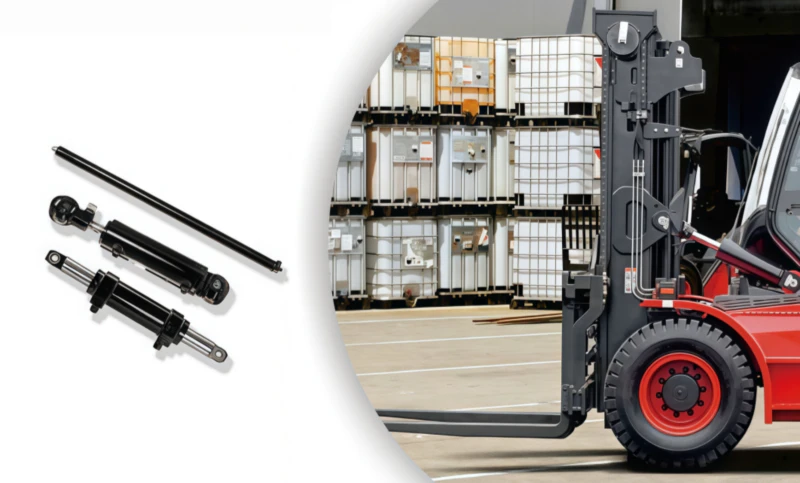
Key Dimensional Parameters for Compatibility Assessment
When evaluating tilt cylinder compatibility, five critical dimensional parameters must match precisely between the existing equipment and proposed replacement or upgrade cylinder:
1. Bore Diameter (Cylinder Diameter): The bore diameter, measured in millimeters, determines the pressure-generating force of the cylinder. Common bore diameters range from 40mm to 90mm. A cylinder with a 50mm bore generates approximately 19,635 Newtons of force at 100 bar pressure, while a 70mm bore generates 38,485 Newtons under identical conditions. Bore diameter mismatches create cascading compatibility problems: undersized bores reduce tilt speed and force, while oversized bores increase system pressure and stress mast components.
2. Rod Diameter (Piston Rod Diameter): The rod diameter, typically 70-80% of the bore diameter, must match precisely for proper sealing and pressure balance. Standard ratios maintain specific pressure differentials between cap-end and rod-end ports. A mismatch creates unbalanced forces that cause uneven tilt speed (faster tilt-up than tilt-down, for example) or require control valve adjustment that increases wear on proportional control spool elements.
3. Stroke Length (Maximum Extension): Stroke lengths vary from 100-500mm depending on mast design requirements. A cylinder with insufficient stroke cannot fully tilt the mast forward or backward, while excessive stroke creates a physically oversized cylinder that won’t fit within the mast cavity. Stroke length directly affects tilt angle range; a 200mm stroke on a 3-meter mast produces approximately 3.8-degree tilt, while the same stroke on a 1.5-meter mast produces nearly 7.6-degree tilt.
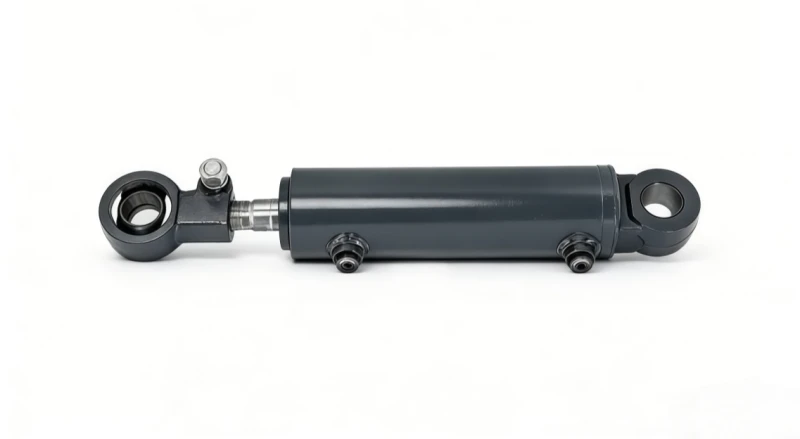
4. Mounting Configuration: Tilt cylinders use various mounting methods: flange mounts (with SAE or ISO standard bolt patterns), trunnion mounts (single clevis pin), double-clevis rod-end mounts, or custom bracket designs. The mounting interface must match the existing mast structure precisely. Many older forklifts use proprietary mounting designs that are incompatible with modern ISO-standard cylinders, requiring adapter plates or mast modification.
5. Port Configuration and Porting Size (Flow Rate Requirements): Port size (typically 1/2-inch, 3/4-inch, or 1-inch NPT or ISO connections) determines maximum flow rate capacity. A small-ported cylinder rated for 30 liters/minute cannot be directly substituted with a small-ported cylinder rated for 50 liters/minute without system recalibration. Proportional control valve systems are tuned for specific flow characteristics; mismatched porting can cause jerky, unpredictable tilt response despite correct bore and rod dimensions.
Pressure Rating and System Compatibility Considerations
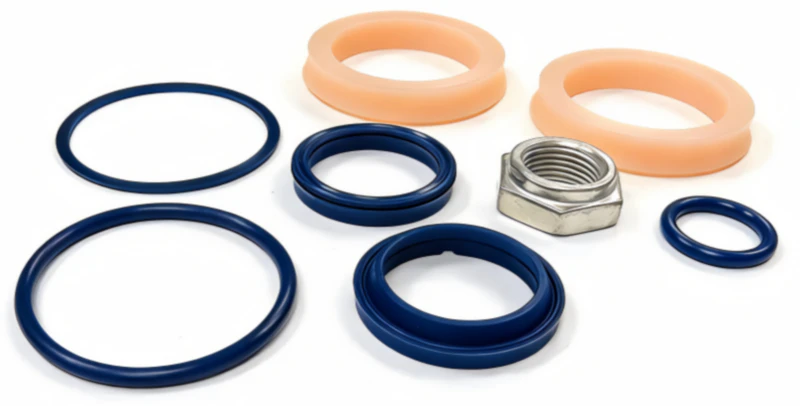
Pressure rating compatibility extends beyond simple maximum working pressure specifications. A cylinder rated for 280 bar maximum pressure (common on newer equipment) cannot be safely used in systems designed for 210 bar maximum pressure operation. The seals and internal components are engineered for specific pressure ranges, and operating a 210-bar-rated cylinder at 280 bar accelerates seal degradation and risks catastrophic failure.
Conversely, installing a 210-bar cylinder in a system designed for 280 bar leaves you vulnerable to seal failure if system pressure exceeds the cylinder’s safe operating range during peak load conditions. The system’s relief valve setting should theoretically prevent overpressurization, but relief valve drift and other factors can allow brief pressure spikes that damage undersized cylinders.
Many forklift manufacturers design systems with specific pressure ratios between tilt and lift circuits. Toyota’s proportional valve systems, for example, maintain approximately 70% of system pressure on the tilt circuit to provide smooth proportional control. A cylinder designed for 280 bar in a Toyota lift circuit might actually experience 196 bar during typical operation (0.70 × 280 bar). Substituting a cylinder rated only for 180 bar creates a safety hazard where normal operation exceeds the cylinder’s safe pressure range.
Temperature rating compatibility also impacts pressure performance. Seals and hydraulic fluid have temperature-dependent performance characteristics. A cylinder rated to +100°C maximum operating temperature used in a foundry or steel mill environment where ambient temperatures reach 45-50°C combined with friction heat can experience internal temperatures exceeding safe limits. High-temperature operation accelerates seal aging, reducing effective pressure capacity.
Identifying Compatible Replacement Cylinders for Your Forklift Equipment
The practical process of identifying compatible replacement cylinders requires systematic information gathering and careful matching:
Step 1: Locate Equipment Documentation: Your forklift’s original equipment manufacturer (OEM) documentation—typically found on a nameplate affixed to the mast or frame—contains the model number, year of manufacture, and often direct references to component specifications. Request OEM service manuals from your dealer or manufacturer; these documents explicitly list compatible replacement parts with part numbers and dimensional specifications.
Step 2: Measure Critical Dimensions: If OEM documentation is unavailable, measure the existing cylinder’s bore diameter (external measurement at the widest point), rod diameter (external measurement of the piston rod), stroke length (measure from full retraction to full extension), and mounting flange bolt pattern. Photograph the mounting configuration and measure bolt spacing using calipers or a ruler. Document all port connections (size and type) and any unique features like integrated relief valves or pressure lines.
Step 3: Cross-Reference Compatible Part Numbers: Use cross-reference databases maintained by major aftermarket cylinder suppliers (Bosch Rexroth, Parker, Eaton) to identify cylinders with matching specifications. Many manufacturers publish cross-reference guides matching OEM part numbers to equivalent products. Provide your cylinder measurements and equipment model to cylinder specialists who can recommend compatible options.
Step 4: Verify Pressure and Flow Compatibility: Confirm that the proposed replacement cylinder has pressure rating equal to or exceeding your system’s maximum operating pressure. If your hydraulic system operates at 210 bar, specify cylinders rated for at minimum 210 bar, preferably 240 bar or higher to provide safety margin. Verify flow rate capacity matches your system’s pump flow (typically 40-80 liters/minute on standard forklifts).
Step 5: Test in Pilot Installation: When possible, arrange a trial installation on one piece of equipment before committing to fleet-wide replacement. Monitor tilt speed, smoothness, and proportional control response during a 4-8 hour operational trial. This approach identifies compatibility issues before widespread implementation.
Common Compatibility Mistakes and How to Avoid Them
Mistake 1: Assuming Bore Diameter Alone Ensures Compatibility: Many fleet managers make the error of matching only the bore diameter while ignoring rod diameter, stroke, mounting, and pressure requirements. This approach frequently fails because a cylinder with the correct bore but wrong rod diameter produces unbalanced forces. Tilt speed becomes unpredictable, and seal wear accelerates due to uneven loading.
Mistake 2: Substituting Higher-Pressure Cylinders Without System Verification: Installing a 280-bar cylinder (newer standard) into a system designed for 210 bar operation seems like a “safety upgrade,” but it creates hidden dangers. If the control valve can’t properly modulate the higher pressures, tilt becomes jerky and difficult to control. More critically, if a proportional valve spool develops internal leakage, the higher pressures can cause unintended rapid tilt motion, creating a safety hazard.
Mistake 3: Overlooking Mounting Configuration Differences: Cylinder bore and rod dimensions might be identical, but mounting configuration differences can prevent physical installation. A cylinder with a SAE-flange mount cannot be directly substituted for one with an ISO-flange mount, even if bolt circle diameter is similar. The height of the flange, bolt spacing precision, and mounting surface geometry differ sufficiently to prevent proper installation or create misalignment that stresses the mast.
Mistake 4: Ignoring Porting Size and Flow Rate Mismatches: A cylinder with 1/2-inch ports limits flow to approximately 30 liters/minute maximum. Retrofitting this small-ported cylinder onto a system designed for 50-liter/minute flow creates a bottleneck. System pressure spikes in attempts to force the required flow through the small ports, accelerating seal wear and creating safety risks from overpressurization.
Mistake 5: Failing to Account for Seal Material and Fluid Compatibility: Some aftermarket cylinders use nitrile seals as cost-reduction measures. If your hydraulic system uses biodegradable HETG fluid, nitrile seals swell and fail within hours. Matching seal materials to your hydraulic fluid type is as critical as matching mechanical dimensions.
Special Considerations for Fleet Standardization
Many larger fleet operations face complexity from equipment acquired over multiple years from different manufacturers. A fleet might include Toyota 8FGU25T forklifts (25,000 lb capacity), Hyster S70 forklifts, and Caterpillar GP25NT models—all three brands with different tilt cylinder specifications. This diversity creates logistical challenges in maintaining spare cylinder inventory.
Fleet standardization initiatives attempt to consolidate diverse equipment onto a smaller number of standardized cylinder types. This requires careful planning. If a fleet operates primarily Toyota and Mitsubishi equipment (which share some compatibility), focusing spare inventory on cylinders compatible with both brands reduces storage requirements and improves service speed. A well-planned standardization effort can reduce spare parts inventory by 20-30% while improving equipment uptime.
Some fleets adopt universal ISO-standard cylinders as their standardization target. These cylinders, meeting ISO 4401-05 cavity size standards and ISO 6162 pressure port requirements, offer compatibility across multiple equipment types. However, this approach requires initial conversion of non-standard equipment (often involving adapter plates or mast modification) and must account for pressure rating adjustments across the fleet.
The most successful fleet standardization programs balance three factors: (1) maximizing compatibility to reduce inventory complexity, (2) matching cylinder specifications exactly to equipment design parameters, and (3) avoiding forced upgrades that create unexpected operational changes or safety risks for operators.
.webp)
Hydraulic System Configuration and Proportional Control Compatibility
Beyond physical compatibility, proportional control system compatibility requires careful attention. Older forklift models often use simple open-center proportional valve systems that respond to operator joystick input by varying flow through fixed orifices. Newer equipment increasingly uses closed-center, pressure-compensated proportional valves that sense system pressure and automatically adjust flow to maintain constant differential pressure.
A cylinder designed for open-center system operation might perform acceptably in a closed-center system, but the proportional control response characteristics change dramatically. Open-center systems deliver high flow at low pressure, creating rapid acceleration followed by gradual slowdown. Closed-center systems maintain constant pressure differential, creating more uniform acceleration and smoother proportional control feel.
Swapping a narrow-ported cylinder (2.5 cm² flow area) for one with larger ports (5 cm² flow area) in a closed-center system can create hunting oscillation around the operator’s desired position. The larger-ported cylinder accepts flow too readily, causing overshoot, system pressure spike from overshoot reversal, and subsequent undershoot cycle that repeats. Operators describe this sensation as “jumpy” or “uncontrollable” proportional response.
Specification compatibility verification must therefore include proportional control system type, pressure compensation settings, valve spool sizing, and pilot pressure levels. Cylinder manufacturers provide detailed specifications addressing these factors. Matching these specifications ensures that replacement cylinders provide the same proportional control characteristics as original equipment, maintaining operator experience and safety performance.
International Standards and Compatibility Frameworks
International standardization efforts have progressively improved tilt cylinder compatibility across equipment brands. ISO 4401-05 defines standard cavity sizes for proportional directional control valves (NG10 cavity at 100mm × 55mm × 53mm), enabling valve interchangeability across brands. ISO 6162 standardizes pressure port thread sizing and connection types. ISO 3471 establishes rollover protective structure (ROPS) and tilt testing procedures that influence tilt cylinder design.
However, ISO compliance doesn’t guarantee full compatibility. A valve meeting ISO 4401-05 cavity size specifications can physically mount in ISO-compliant equipment, but internal porting and flow rating still require verification. Many manufacturers supply valves with internal porting specifically designed for their equipment’s hydraulic circuit geometry. Installing an ISO-compliant valve with porting designed for one circuit into equipment with different circuit geometry creates pressure and flow imbalances.
Similarly, cylinders meeting ISO 6162 pressure port standards can physically connect to ISO-compliant systems, but port flow capacity must match the system’s pump displacement and rotation speed. A cylinder with ISO 6162 porting that can accept only 30 liters/minute (via a 3/8-inch BSPP connection) cannot replace one designed for 60 liters/minute (via a 1/2-inch BSPP connection), despite both meeting ISO standards.
ISO standards establish minimum compatibility frameworks that enable basic interchangeability but do not guarantee performance equivalence. Full compatibility verification still requires detailed specifications beyond standards compliance: bore/rod dimensions, stroke length, pressure rating, flow capacity, mounting geometry, and proportional control system integration requirements.
Working with Manufacturers and Specialists for Compatibility Verification
When compatibility uncertainty exists, engaging equipment manufacturers and cylinder specialists prevents costly mistakes. Provide manufacturers with detailed equipment specifications: model number, year of manufacture, current cylinder part number (if available), and measured dimensions. Reputable manufacturers respond with definitive compatibility assessments backed by technical documentation.
Specialized cylinder remanufacturers and hydraulic system integrators often maintain extensive compatibility databases built from decades of equipment service experience. These specialists can identify compatible options from dozens of manufacturers, cross-reference specifications against system parameters, and recommend solutions accounting for fleet-specific constraints like limited budget or maintenance facility capabilities.
The most valuable service specialists provide includes not just cylinder recommendations but also detailed installation procedures, system adjustment parameters (proportional valve spool gain, pressure relief setting adjustments), and performance verification protocols. A specialist who recommends a cylinder but fails to specify required proportional valve tuning adjustments leaves you vulnerable to poor proportional control performance despite technically correct cylinder specifications.
Documentation of compatibility decisions creates valuable institutional knowledge. Recording why specific cylinder types were selected, what compatibility challenges were addressed, and what performance characteristics result from specific choices builds a knowledge base that accelerates future maintenance and upgrade decisions. Fleet operations with detailed compatibility records reduce troubleshooting time by 40-60% when similar equipment failures occur.
Conclusion: Ensuring Long-Term Equipment Performance Through Proper Compatibility
Forklift tilt cylinder compatibility extends far beyond simply matching bore diameters. Successful cylinder selection and installation requires understanding dimensional specifications, pressure ratings, flow requirements, mounting configurations, proportional control system integration, and seal material compatibility. Each parameter contributes to overall system performance, and mismatches in any dimension create safety risks, operational inefficiencies, or premature component failure.
Whether managing a single forklift or a complex multi-brand fleet, systematic compatibility verification prevents costly mistakes. Document your equipment specifications, maintain detailed compatibility records, engage qualified specialists when uncertainty exists, and test new cylinder installations before fleet-wide implementation. These practices ensure that replacement and upgrade cylinders perform reliably for the full product lifespan, maintaining equipment safety and maximizing return on investment in maintenance and improvement initiatives.
For specific compatibility questions regarding your forklift equipment, contact our engineering support team who can review your equipment specifications and provide definitive compatibility guidance. We maintain comprehensive specifications for all major forklift brands and can identify optimal replacement and upgrade cylinder solutions tailored to your specific equipment configuration and operational requirements. Our technical resource library includes detailed compatibility charts and cross-reference guides for most common forklift models. For detailed information on pressure testing procedures that verify cylinder compatibility after installation, see our comprehensive industry technical resources on precision bearing and hydraulic component verification.