.webp)
Product Description
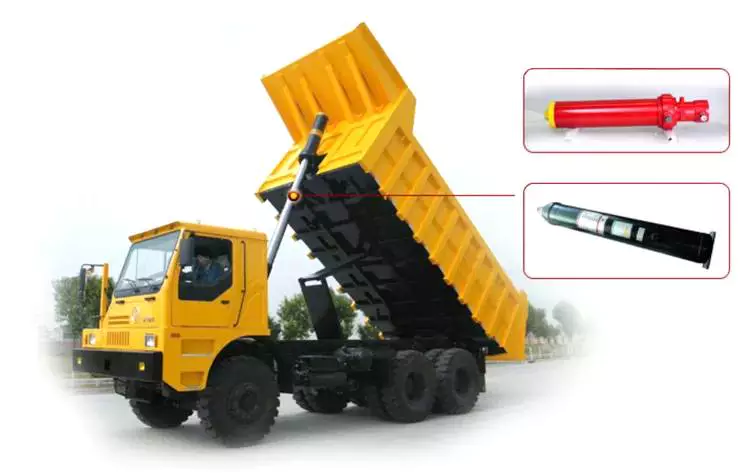
Custom 2 3 4 5 6 Stages hydraulic Cylinder for Battery Charging Dump Truck Made in China
Product Specifications:
| Item | Specifications |
| Function | Lifting/lowering the truck body for cargo dumping |
| Bore diameter | 120mm-480mm,customizable |
| Bod diameter | 90mm-390mm,customizable |
| Stroke | 3000mm-12000mm,customizable |
| Stage | 2-6stages,customizable |
| Surface treatment of piston rod | HaHard Chrome Plating,Electroplated Milky White Chromium+Hard Chromium,Nickel Plating+Hard Chromium Plating,High-Velocity Oxygen-Fuel CrC NiC,Ceramic Coating,Nitriding,Laser Cladding |
| Work Pressure | Maximum 38MPa,customizable |
| Material | High tensile cold drawn tube, precision honed for extended seal life |
| Mounting | Earring,Flange,Clevis.Foot,Trunnion,customizable |
| Seal Type | Parker,NOK, Hallite or as customer’s requirement |
| Warrenty | 18 months |
| MOQ | 1 pcs |
| Production Time | Based on order quantity.normally 30-40 days. |
| Certification | ISO9001,CE, SGS |
| Packaging | metal case,plywood case,carton or as requirement |
| Service | OEM & ODM |
| Price Advantage | Competitive factory price with guaranteed quality |
| Business Type | Manufacturer |
Product Display:
Mounting Method:
Appliactions:Mining Machinery,Mining Dump Truck
Other Related Products
Our Factory:
Quality Assurance:
| Inspection Type | Inspection Standard |
| Raw Material Inspection | Before storage, QC takes the measurement of the raw materials. |
| Process Material Inspection | During the production, QCs conduct a random inspection. Before the hydraulic cylinder parts transferred to the next process, QCs takes inspection. |
| Final Function Testing | All the hydraulic cylinders take hydraulic function test |
Inspection of Mechanical Properties of Raw Materials
Process Inspection
Final Testing
Packing & Delivery:
About US:
Our Certificate
Our Main Customers
ZheJiang Tianjian Hydraulic Technology Co.,Ltd is specializing in the production of various types of hydraulic cylinders as well as cylinder barrel, piston cylinder and other cylinder accessories.
As a highly specialized manufacturer of hydraulic cylinders, tianjian provides design optimization solutions and reliable products to many customers at home and abroad. No matter in construction machinery, railway bridge machinery, port ship machinery, metallurgy and mining machinery, oil and light industry machinery, special vehicles and other industries, tianjian can provide various standard and non-standard hydraulic cylinder design optimization schemes and products according to users’ requirements, and provide integrated services for perfection and quality.
If possible, when contact with us, please apply information as below
|
Bore |
Rod |
Stroke |
Work Pressure |
Mounting |
Work environment |
|
|
|
|
|
|
|
Or you can offer us your sketch diagram or photos so that we could understand you exactly meaning, help us avoid mistakes.
And if you have samples, we can manufacture according to your samples after sending to us.
Welcome to our factory if you have any time.
Your satisfaction is our biggest motivation.
Now, you can contact with us for any question or inquiry.
FAQ:
1, What does your company do?
A: we are a supplier of high quality hydraulic products including Hydraulic Cylinder, Hydraulic Motor, Hydraulic Power Pack, Hydraulic station and other Hydraulic components.
2, Are you a manufacture or a trading company?
A: We are a manufacturer.
3, What certificate do you have?
A: All our factories are ISO certificated. And our main suppliers of materials and parts are with CE, RoHS, CSA and UL certificates.
4, How long is your delivery time?
A: The delivery time depends on different products and quantity. The cylinder usually need about 45-60 days and the Motor need about 30-50 days.
5, Can you make parts as customer’s requirement or drawing?
A: Yes, we can OEM for you as your drawings. Our engineer also can give you professional support for technical suggestions.
6, What kind of payment terms do you accept?
A: We prefer T/T through bank. 30% when order is confirmed and 70% before shipment. L/C is also acceptable for amount over 20,000USD.
7, What is your warranty policy?
A: All our products are warranted for 1 full year from date of delivery against defects in materials and workmanship. This warranty does not cover parts that are worn out through the course of normal operation or are damaged through negligence. We serious remind that unclean hydraulic oil will definitely cause damage to your Hydraulic components. And this damage is not included in the warranty range. So we strongly suggest you to use new clean oil or make sure the system oil are clean when using our parts
| Certification: | GS, RoHS, CE, ISO9001 |
|---|---|
| Pressure: | High Pressure |
| Work Temperature: | High Temperature |
| Acting Way: | Double Acting |
| Working Method: | Straight Trip |
| Adjusted Form: | Regulated Type |
| Samples: |
US$ 600/Set
1 Set(Min.Order) | |
|---|
| Customization: |
Available
|
|
|---|
Can hydraulic cylinders be adapted for specialized applications like material handling?
Yes, hydraulic cylinders can be effectively adapted for specialized applications such as material handling. The versatility, power, and precise control offered by hydraulic cylinders make them well-suited for a wide range of material handling tasks. Hydraulic systems, including cylinders, are commonly used in industrial settings to lift, position, push, pull, and manipulate various types of materials. Here’s a detailed explanation of how hydraulic cylinders can be adapted for specialized material handling applications:
1. Lifting and Lowering:
– Hydraulic cylinders are commonly used for lifting and lowering heavy loads in material handling applications. By utilizing the force generated by hydraulic pressure, cylinders can provide the necessary power to lift and hold loads at different elevations. The precise control offered by hydraulic systems allows for accurate positioning of materials, ensuring efficient and safe lifting operations.
2. Pushing and Pulling:
– Hydraulic cylinders are capable of generating substantial pushing and pulling forces, making them ideal for applications that involve moving or manipulating materials. They can be used to push or pull heavy objects, control the movement of conveyors or rollers, or engage mechanisms for material transfer. The ability to exert high forces with precise control enables hydraulic cylinders to efficiently handle a variety of material handling tasks.
3. Tilting and Rotating:
– Hydraulic cylinders can be adapted to provide tilting and rotating functions in material handling equipment. By integrating cylinders into the design, equipment such as forklifts, cranes, or material handling arms can tilt or rotate to facilitate material placement or maneuvering. Hydraulic cylinders offer the required force and control to achieve smooth and controlled tilting or rotating motions, enhancing operational efficiency in material handling processes.
4. Gripping and Clamping:
– Hydraulic cylinders can be utilized to provide gripping and clamping functions for secure material handling. By incorporating specialized gripping or clamping mechanisms with hydraulic actuation, materials of various shapes and sizes can be securely held or clamped during transportation or processing. Hydraulic cylinders enable precise and adjustable gripping or clamping forces, ensuring the safe and reliable handling of materials.
5. Material Compaction and Forming:
– Hydraulic cylinders can be adapted for material compaction and forming applications. For example, in the production of bricks, hydraulic cylinders are used to apply high pressure and force to compact the raw materials into desired shapes. Similarly, in metal forming processes, hydraulic cylinders are employed to exert force on metal sheets or components, enabling precise shaping and forming operations.
6. Conveyor and Sorting Systems:
– Hydraulic cylinders can be integrated into conveyor and sorting systems to facilitate material movement and sorting. By incorporating hydraulic actuators, conveyor belts or sorting mechanisms can be efficiently controlled for optimal material flow and distribution. Hydraulic cylinders provide the necessary force and control to handle varying load capacities and adjust the speed and position of material transfer, improving the overall efficiency of handling and sorting operations.
7. Customized Designs:
– Hydraulic cylinders can be customized and adapted to meet specific requirements of specialized material handling applications. Engineers can design cylinders with unique dimensions, stroke lengths, mounting options, and sealing arrangements to fit into equipment or systems with specific space limitations or operating conditions. Customized hydraulic cylinders ensure optimal performance and compatibility for specialized material handling tasks.
In summary, hydraulic cylinders can be effectively adapted for specialized material handling applications, offering the necessary force, control, and versatility required in various material handling tasks. Whether it involves lifting and lowering, pushing and pulling, tilting and rotating, gripping and clamping, material compaction and forming, or integration into conveyor and sorting systems, hydraulic cylinders provide reliable and efficient solutions. Their adaptability, precise control, and ability to handle heavy loads make hydraulic cylinders a valuable component in optimizing material handling processes across different industries.
Handling the Challenges of Minimizing Fluid Leaks and Contamination in Hydraulic Cylinders
Hydraulic cylinders face challenges when it comes to minimizing fluid leaks and contamination, as these issues can impact the performance, reliability, and lifespan of the system. However, there are several measures and design considerations that help address these challenges effectively. Let’s explore how hydraulic cylinders handle the challenges of minimizing fluid leaks and contamination:
- Sealing Systems: Hydraulic cylinders employ advanced sealing systems to prevent fluid leaks. These systems typically include various types of seals, such as piston seals, rod seals, and wiper seals. The seals are designed to create a tight and reliable barrier between the moving components of the cylinder and the external environment, minimizing the risk of fluid leakage.
- Seal Material Selection: The choice of seal materials is crucial in minimizing fluid leaks and contamination. Hydraulic cylinder manufacturers carefully select seal materials that are compatible with the hydraulic fluid used and resistant to wear, abrasion, and chemical degradation. This ensures the longevity and effectiveness of the seals, reducing the likelihood of leaks or premature seal failure.
- Proper Installation and Maintenance: Ensuring proper installation and regular maintenance of hydraulic cylinders is essential for minimizing fluid leaks and contamination. During installation, attention should be given to proper alignment, torqueing of bolts, and adherence to recommended procedures. Regular maintenance includes inspecting seals, replacing worn-out components, and addressing any signs of leakage promptly. Proper maintenance practices help identify and rectify issues before they escalate and cause significant problems.
- Contamination Control: Hydraulic cylinders incorporate measures to control contamination and maintain fluid cleanliness. This includes the use of filtration systems, such as in-line filters, to remove particles and contaminants from the hydraulic fluid. Additionally, hydraulic reservoirs often have breathers and desiccant filters to prevent moisture and airborne contaminants from entering the system. By controlling contamination, hydraulic cylinders minimize the risk of damage to internal components and maintain optimal system performance.
- Environmental Protection: Hydraulic cylinders may be equipped with protective features to safeguard against external contaminants. For example, bellows or protective boots can be installed to shield the rod and seals from debris, dirt, or moisture present in the operating environment. These protective measures help extend the life of the seals and enhance the overall reliability of the hydraulic cylinder.
In summary, hydraulic cylinders employ sealing systems, appropriate seal materials, proper installation and maintenance practices, contamination control measures, and environmental protection features to handle the challenges of minimizing fluid leaks and contamination. By implementing these measures, manufacturers can ensure reliable and long-lasting hydraulic cylinder performance, minimize the risk of fluid leakage, and maintain the cleanliness of the hydraulic system.
What factors should be considered when selecting the right hydraulic cylinder for an application?
When selecting the right hydraulic cylinder for an application, several important factors need to be considered. These factors help ensure that the chosen hydraulic cylinder is suitable for the specific requirements of the application and will perform reliably. Here are the key factors to consider:
1. Load Requirements:
– One of the crucial factors to consider is the load requirement of the application. Determine the maximum load that the hydraulic cylinder needs to handle. Consider both the static load (when the cylinder is stationary) and the dynamic load (when the cylinder is in motion). The load requirement will impact the cylinder’s bore size, rod diameter, and overall strength. Choose a hydraulic cylinder with a load capacity that exceeds the application’s maximum load to ensure safety and longevity.
2. Stroke Length:
– The stroke length refers to the distance the hydraulic cylinder needs to extend and retract to perform the desired motion. Measure the required stroke length based on the application’s operational requirements. It is essential to choose a hydraulic cylinder with a stroke length that matches or exceeds the required distance. Consider any potential variations or adjustments in the stroke length that may be needed in the future.
3. Operating Pressure:
– Consider the operating pressure required for the application. The hydraulic cylinder must be capable of withstanding the maximum pressure within the hydraulic system. Ensure that the selected cylinder has a pressure rating that exceeds the application’s maximum operating pressure. This ensures safety and prevents premature failure.
4. Speed Requirements:
– Determine the required speed of the hydraulic cylinder’s movement for the application. Consider both the extension and retraction speeds. Select a cylinder that can achieve the desired speed while maintaining precise control and stability. It is important to choose a cylinder that can handle the required speed without compromising performance or safety.
5. Mounting:
– Evaluate the available space and mounting requirements for the hydraulic cylinder. Consider the mounting type (such as flange, foot, trunnion, or clevis), the available mounting points, and any specific mounting constraints. Ensure that the selected cylinder can be easily and securely mounted in the desired location.
6. Environmental Factors:
– Assess the environmental conditions in which the hydraulic cylinder will operate. Consider factors such as temperature extremes, humidity, exposure to chemicals, dust, or corrosive substances. Choose a cylinder that is designed to withstand the specific environmental conditions of the application. This may involve selecting appropriate materials, coatings, or seals to ensure the longevity and performance of the cylinder.
7. Cylinder Configuration:
– Determine the appropriate cylinder configuration based on the application’s requirements. Consider factors such as single-acting or double-acting cylinders, telescopic cylinders for limited space, or custom configurations for unique applications. Evaluate the specific needs of the application to select the most suitable cylinder configuration.
8. Maintenance and Serviceability:
– Consider the maintenance and service requirements of the hydraulic cylinder. Evaluate factors such as ease of access for maintenance, availability of spare parts, and the reputation of the manufacturer or supplier in terms of customer support and after-sales service. Choosing a reliable and reputable brand can ensure ongoing support and availability of spare parts when needed.
9. Compliance and Standards:
– Depending on the industry and application, certain compliance standards may need to be met. Consider any industry-specific regulations, safety standards, or certifications that the hydraulic cylinder should comply with. Ensure that the selected cylinder meets the required standards and certifications for the application.
10. Cost and Budget:
– Finally, consider the cost and budget for the hydraulic cylinder. While it is important to select a cylinder that meets the application’s requirements, it is also necessary to consider the overall cost-effectiveness. Evaluate the initial purchase cost, long-term maintenance costs, and the expected lifespan of the cylinder. Balancing the cost and quality will help in selecting a hydraulic cylinder that provides the best value for the application.
By considering these factors in the selection process, it becomes possible to choose the right hydraulic cylinder that meets the specific requirements of the application in terms of load capacity, stroke length, operating pressure, speed, mounting, environmental conditions, maintenance needs, compliance, and cost-effectiveness. Proper selection ensures optimal performance, reliability, and longevity of the hydraulic cylinder in the intended application.


editor by CX 2023-10-17