.webp)
Introduction
In the expanding frontiers of sub-arctic resource extraction, high-latitude civil infrastructure, and high-altitude defensive logistics, structural survivability is the absolute boundary separating profitable execution from catastrophic systemic failure. Heavy machinery operating in extreme cold zones—such as polar material handlers, northern open-pit mining shovels, and sub-zero telescopic crawler cranes—faces an environment that fundamentally alters the physical properties of engineering materials. When ambient temperatures drop to negative 40 degrees Celsius or lower, conventional industrial equipment reaches its thermodynamic threshold. Under these unyielding thermal pressures, ordinary materials suffer sharp drops in structural resilience, converting standard high-ductility steel alloys into brittle structures vulnerable to fast micro-fractures under nominal static loads.
At the absolute core of these sub-zero industrial mechanisms lies the fluid power loop, where heavy-duty linear cylinders act as the primary structural muscle bearing the brunt of the load. Every high-force lifting cycle, every boom pitch correction, and every stabilization outrigger lock depends entirely on the structural integrity of these actuators. Designing a cylinder capable of surviving negative 40 degrees Celsius requires moving past standard fluid power rules and entering the fields of low-temperature metallurgy and advanced elastomer chemistry. This technical analysis provides an exhaustive evaluation of low-temperature cylinder engineering, detailing the mechanics of the ductile-to-brittle transition zone, Charpy V-notch energy standards, and the viscoelastic modulus recovery pathways of sealing systems necessary to guarantee continuous, zero-leak fluid power execution.
Core Application Scenarios Breakdown
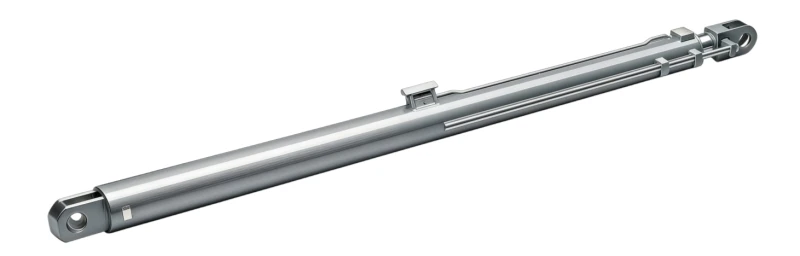
Sub-zero structural machinery relies on stable linear force deployment to manage high-tonnage weights on unstable frozen terrains. To appreciate the exact performance envelopes required, we must examine the specific mechanics across the primary cold-weather applications.
A
Arctic Crawler Crane Boom Backstop and Luffing Mechanisms
Application Description: High-capacity lattice boom cranes and heavy telescopic crawlers configured for sub-zero infrastructure maintenance deploy large-bore luffing and boom backstop actuators. The boom stop assembly serves as a critical structural safety catch, generating reactive linear resistance to prevent backward boom over-rotation during unpredictable polar wind changes. These components must retain full load capability at high boom elevations, stabilizing multi-ton payload profiles on uneven frozen foundations.
Extreme Challenges: The primary mechanical threat in arctic crane luffing is the combination of intense static weight loads and rapid kinetic wind loading. At negative 40 degrees Celsius, standard structural steels can cross their Ductile-to-Brittle Transition Temperature (DBTT). If the crane structure encounters a sudden wind load change, the backstop cylinder faces an instant mechanical energy spike. If the metal lacks sufficient sub-zero impact toughness, these energy surges can trigger immediate brittle fracture propagation across the cylinder head or clevis mounts without any visible plastic deformation warning.
Technical Countermeasures: Actuators deployed in arctic crane systems must be manufactured with specialized low-temperature alloy steels that undergo strict grain refinement processes. Every load-bearing block utilizes direct-flanged over-center safety valves to prevent oil line pressure loss, while the mounting points are engineered to absorb sudden kinetic energy shifts smoothly.
B
Northern Open-Pit Mining Shovel Excavation Attachments
Application Description: Massive hydraulic mining shovels and excavators operating in northern regions deploy high-force bucket tilt and dipper door cylinders. These linear rams drive the bucket to tear through frozen permafrost layers, dense iron ore beds, and frozen overburden strata, continuously packing high-tonnage materials into heavy haul trucks.
Extreme Challenges: Shovel actuators face relentless, high-frequency shock loads. When the bucket teeth strike hard permafrost obstacles, a severe mechanical impact wave travels backwards directly into the extended cylinder rod. In extreme cold, the fluid viscosity spikes significantly, causing flow restriction through the control orifices. This fluid resistance generates severe localized pressure spikes behind the piston head, threatening to compromise internal clearance boundaries and degrade ordinary sealing polymers that have lost their flexibility due to the cold.
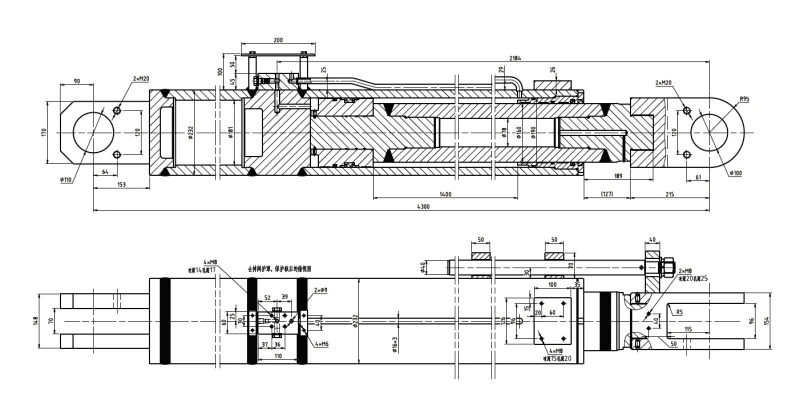
Technical Countermeasures: Mining-grade cold-climate actuators utilize thick-walled seamless steel tubes with extended internal overlap distances between the guide bushes to distribute lateral forces. The internal piston assemblies integrate rapid-acting deceleration cushioning to absorb fluid spikes safely, while the external rod wipers are reinforced with spring-energized scrapers to remove field ice sheets cleanly.
Low-Temperature Charpy V-Notch Metallurgy
To prevent catastrophic brittle failure in heavy components at negative 40 degrees Celsius, standard carbon steels must be replaced by alloy compositions verified by Charpy V-notch impact testing. When standard ferritic steels enter sub-zero temperatures, their body-centered cubic (BCC) crystal structure experiences an increase in yield strength but a sharp decline in plastic deformation capacity. This shifts the material past its ductile-to-brittle transition point, where minimal impact energy can trigger unstable transgranular cleavage fractures originating from microscopic surface stress risers.
Our specialized sub-zero cylinder lines utilize high-yield strength seamless steel tubing derived from fine-grain treated ST52.3 (E355) alloy steel modifications or premium nickel-alloyed structural steels. Aluminum or vanadium micro-additions are introduced to generate an ultra-fine grain size profile, which restricts crack propagation across grain boundaries. Every batch of steel undergoes standardized Charpy V-notch impact testing, verifying minimum impact energy retention of 27 Joules at negative 40 degrees Celsius. Piston rods are machined from high-tensile alloy steel and subjected to high-frequency induction hardening to a uniform case depth of 1.5mm to 2.5mm, reaching an external hardness profile of HRC 55 to 60. This induction layer provides the rigid foundation needed to resist impact damage, which is then protected beneath a 50 micrometer duplex hard chrome plating layer to ensure superior resistance to moisture corrosion. The internal barrel bore is processed via precision CNC skiving and roller burnishing to ensure an inner surface finish below Ra 0.2 micrometers, creating an ultra-smooth mirror finish that preserves hydrodynamic oil films under high fluid pressures.
Seal Modulus Recovery and Polymeric Physics
While metallurgical chemistry ensures the structural survival of the cylinder shell, seal behavior under low temperatures dictates its pressure containment capability. As standard elastomers approach freezing thresholds, they lose their viscoelastic properties and head toward their Glass Transition Temperature ($T_g$). In this transition zone, the polymer chain mobility freezes, causing an intense spike in the material’s elastic modulus. This thermal contraction turns flexible sealing lips into rigid, glass-like rings that cannot adapt to microscopic structural deflections or rod movements. This loss of elasticity creates micro-gaps along the rod surface, leading to external fluid weeping and sudden system pressure drop.
To maintain constant lip compliance, our low-temperature cylinders utilize specialized sealing matrices integrating advanced Japanese NOK polyurethane and low-temperature nitrile (NBR) formulations with a low Glass Transition Temperature. These specialized materials feature high **modulus recovery parameters**, meaning that even when compressed at negative 40 degrees Celsius, the polymer chain retains its internal cross-linked mobility, maintaining its outward sealing force against the steel walls. To prevent pressure bypass and external oil leakage under cold-start conditions, our systems incorporate a multi-layered sealing matrix utilizing premium Japanese NOK components:
| Seal Component | Sub-Zero Material Architecture | Low-Temperature Performance Function |
|---|---|---|
| Primary Rod U-Cup | NOK Low-Temperature Polyurethane | Retains its viscoelastic modulus recovery down to negative 45 degrees Celsius, maintaining constant lip contact against the rod to prevent cold oil weeping. |
| Buffer Ring System | Low-Friction PTFE + Low-Temp NBR Energizer | Remains highly compliant under localized high fluid viscosities, dampening pressure spikes before they hit the primary rod seal. |
| Piston Sealing Guide Matrix | Phenolic Wear Rings + Specialized Energizers | Supports heavy structural side loads without cracking, preventing inner chamber oil bypass and ensuring absolute zero-drift holding. |
| Double-Lip Scraper Wiper | Spring-Energized Metal-Clad NBR Assembly | Maintains structural stiffness to mechanically scrape away thick frost layers and ice sheets from the rod during retraction. |
Our Core Technical Advantages
In a marketplace often saturated with generic aftermarket alternatives, our specialized sub-zero cylinder configurations provide machinery OEMs and fleet operators with verified engineering safety. Selecting our technical manufacturing division ensures complete component security over persistent operational risk.
Bespoke Material Engineering
Our technical group delivers precision custom engineering options, adapting internal tolerances, alloy properties, and base treatments to match your polar infrastructure profiles or high-altitude operations perfectly.
Automated SAW Paths
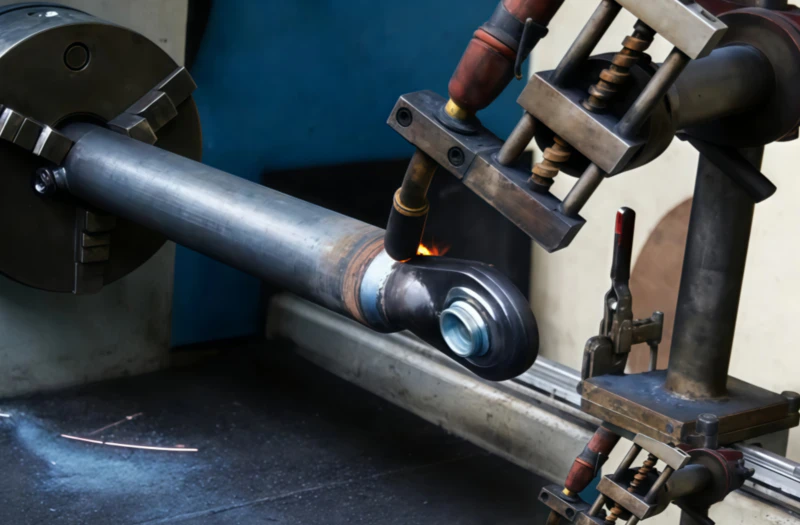
We leverage multi-pass automated Submerged Arc Welding (SAW) paths to establish uniform microstructural depth across critical end caps and trunnions. Every weld undergoes complete Ultrasonic Non-Destructive Testing (NDT).
Minimized Lifecycle TCO
Uniting raw ST52.3 seamless steel bodies with genuine Japanese NOK polyurethanes produces a 45 percent drop in long-term fleet maintenance costs and isolates your operations from unexpected cold-start leaks.
Smart Sensor Protection
We support advanced machine automation by embedding absolute magnetostrictive linear displacement sensors inside internal deep-hole structures, enabling real-time control tracking telemetry under high vibration profiles.
Maintenance Protocol and Troubleshooting Diagnostics
Proactive preventative care is the primary variable required to sustain high fluid performance and secure continuous component uptime across extreme low-temperature operations.
The leading source of linear component degradation in extreme cold operations is oil bypass caused by fluid viscosity spikes. When standard hydraulic fluid cools down to sub-zero temperatures without a proper warm-up sequence, its viscosity index rises exponentially, turning the medium into a dense liquid. If operators run the machine at full speed under these conditions, the thick oil generates extreme backpressures across internal control passages, risking seal lip deformation. Fleet maintenance groups must implement strict fluid monitoring schedules, keeping oil properties aligned with low-viscosity arctic formulas matching ISO 4406 16/14/11 hygiene standards. Furthermore, maintenance teams must verify mounting pin tolerances every 500 operating hours; any accumulated moisture can freeze inside joint clearances, introducing mechanical constraints that accelerate seal wear and cause structural misalignment.
Frequently Asked Questions
Can your hydraulic cylinders adapt to deep cold down to negative 40 degrees Celsius and extreme salt spray concurrently?
Yes, our sub-zero actuators are engineered for these combined conditions. We integrate specialized low-temperature nitrile or fluorocarbon seal matrices designed to maintain modulus recovery, paired with 50 micrometer duplex chrome rod plating to prevent corrosion from industrial moisture or ocean salt sprays.
What is the maximum working pressure and static proof verification pressure of your low-temperature cylinders?
Our standard heavy-duty cold-climate cylinders operate at a continuous nominal working pressure of 35 MPa. To ensure a 4:1 burst safety factor under unexpected dynamic shock loads, every component undergoes a mandatory static proof test up to 52.5 MPa before shipment.
What surface options do you provide to handle highly abrasive mineral grit or ice buildup on the rod?
Beyond our standard 50 micrometer hard chrome layer, we provide advanced options for harsh operating conditions. These include high-velocity oxy-fuel (HVOF) thermal coatings, specialized laser cladding overlays, and custom multi-layer industrial ceramic finishes to maximize surface hardness.
Can your engineering department directly manufacture cylinders using our 3D CAD files (SolidWorks/STEP)?
Yes, our engineering group works directly with native SolidWorks, STEP, IGES, and AutoCAD files. Our design team executes a complete internal drawing assessment to verify fitment and tolerance matching before launching manufacturing tracks.
What is your capacity for integrating internal position sensors for automated winter machinery platforms?
We provide full integration support for smart automation systems. Our facilities execute deep-hole gun drilling and modified rod heads to house magnetostrictive linear displacement sensors or internal LVDT assemblies, providing sub-millimeter position tracking data feedback.
What is your standard minimum order quantity (MOQ) and delivery timeline for custom sub-zero projects?
We employ flexible commercial terms, offering low MOQ options for custom engineering prototypes and developmental projects. Standard prototype production frames run 4 to 6 weeks, while large mass-production OEM batches are arranged to align with your logistical supply chain milestones.
How do your engineers protect long-stroke telescopic actuators from buckling failure under peak loads?
Every long-stroke vertical actuator undergoes structured Euler buckling modeling during our initial design checks. We calculate appropriate rod diameters, configure outer wall profiles, and expand internal guide rings to maintain total structural stability under maximum lift conditions.
What physical quality testing is performed on components before they depart your facility?
We enforce a comprehensive zero-leak validation program. Every single actuator is subjected to dynamic cycle validation, 100 percent hydrostatic pressure hold testing, stroke friction map verification, and internal bypass tests, with full documentation supplied with each delivery.
What is your baseline commercial product warranty and your response strategy for technical assistance?
All our industrial-grade cylinders include a 12-month commercial product warranty. Our technical service center remains staffed to provide diagnostic feedback, component optimization tips, and rapid replacement parts support to limit field downtime footprint.
How do you ensure that a custom cylinder will function correctly with our vehicle’s arctic fluid selection?
During our initial system design review, our technical team evaluates fluid volumetric capacities, maximum oil speeds, port thread styles, and return line backpressure values, confirming that the new actuator matches your pump, valve, and low-temperature fluid parameters perfectly.
Conclusion and Strategic Action Call
The mechanical predictability and overall uptime of high-capacity machinery operating in freezing conditions depends directly on the durability of its linear components. Investing in high-yield ST52.3 seamless steel walls, burnished micro-smooth inner finishes, and authentic Japanese sealing matrices is necessary to protect operational safety thresholds under high fluid pressures. When personnel work on elevated booms or machinery functions in isolated polar zones, component integrity is paramount. If you are seeking a reliable, high-integrity hydraulic cylinder array built for continuous low-temperature operations, connect with our engineering division today. Let us transform your technical operational goals into high-performance industrial assets.