.webp)
Introduction
In the unforgiving landscapes of modern infrastructure development, mining extraction, and heavy civil engineering, operational runtime is the single most critical variable dictating project profitability. Construction machinery—ranging from 100-ton ultra-large excavators to massive wheel loaders and towering lattice-boom cranes—must operate continuously under extreme environmental pressures. Heavy downpours, abrasive silica dust, sub-zero arctic temperatures, and constant high-frequency shock loads form the baseline operating conditions for these mechanized titans. In such hostile environments, a single hour of unplanned machine downtime can trigger tens of thousands of dollars in logistical penalties, idling labor forces, and missed operational milestones.
At the absolute core of these monumental machines lies the fluid power system, where the heavy-duty hydraulic cylinder acts as the non-negotiable physical muscle. Every structural movement, every metric ton of earth excavated, and every massive structural beam lifted depends entirely on the mechanical output of these linear actuators. Whether transferring raw hydraulic energy into steady breakout forces or stabilizing a multi-ton crane framework on uneven terrain, the cylinder is the primary component bearing the brunt of the load. This engineering analysis provides a comprehensive exploration of the specialized application subdivisions of hydraulic actuation in construction machinery, examining the extreme physical challenges faced by these components and the state-of-the-art metallurgical and sealing methodologies required to guarantee absolute operational reliability.
Core Application Scenarios Breakdown
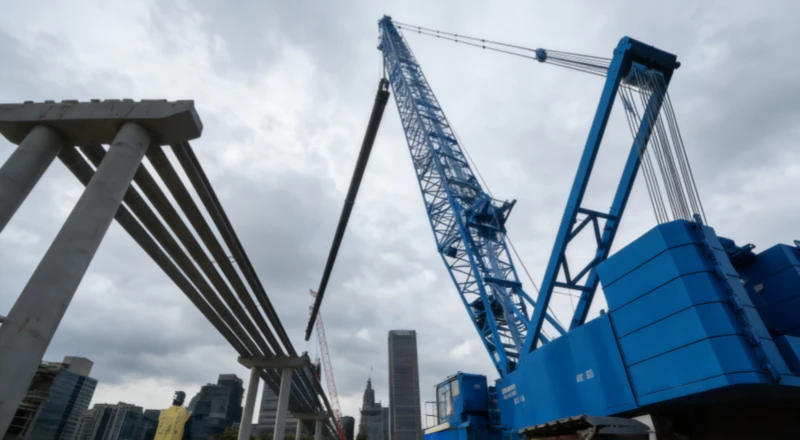
Construction machinery relies on complex, synchronized kinematics to execute high-tonnage tasks. To understand the operational demands placed on a hydraulic cylinder, we must analyze its performance across distinct high-stress machinery applications.
A
Excavator Boom and Arm Actuation
Application Description: In tracked hydraulic excavators, the boom and arm cylinders work in continuous harmony to control the vertical lift, reach, and penetration path of the bucket attachment. The boom cylinders, typically mounted in pairs at the base of the upper superstructure, provide the massive lifting capacity required to hoist raw earth, while the arm cylinder drives the horizontal crowd force necessary to push the bucket through highly compacted soils or rocky strata.
Extreme Challenges: This operating condition subjects the cylinders to immense dynamic stress. Every time the bucket strikes a buried obstacle like rock or concrete, a massive, unmitigated shockwave travels backwards through the structural steel directly into the cylinder rod. Furthermore, during high-velocity digging cycles, heavy lateral loading is introduced when operators swing the superstructure while the bucket is still engaged in the ground, threatening to cause structural deflection or localized scoring along the cylinder guide sleeve.
Technical Countermeasures: To survive these forces, heavy-duty excavator cylinders feature ultra-thick, seamless steel barrels paired with integrated hydraulic cushion valves at both ends of the stroke. These cushion valves slow down the piston velocity smoothly as it approaches the internal mechanical stops, dissipating kinetic energy and preventing pressure spikes from bursting the cylinder seals.
B
Wheel Loader Bucket and Tilt Mechanisms
Application Description: Wheel loaders utilize a Z-bar linkage or parallel lift geometry driven by a combination of hoist and tilt cylinders. The tilt cylinder is responsible for rotating the bucket forward to dump materials or curling it backward to retain high-tonnage loads during transport across uneven quarry floors.
Extreme Challenges: The tilt cylinder operates in an environment characterized by high-frequency vibration and severe external contamination. Positioned directly above the bucket assembly, the extending piston rod is continuously showered with abrasive stone fragments, aggregate dust, and falling debris. If fine silica particles adhere to the rod surface, they can act as an abrasive slurry during the retraction stroke, physically cutting into the primary sealing elements and allowing ambient contaminants to pollute the closed hydraulic circuit.
Technical Countermeasures: Actuators deployed in these material-handling mechanisms must be equipped with aggressive multi-lip scraper systems and heavy-duty metal clad wipers. These wipers mechanically strip away compacted mud and ice sheets from the rod surface before it passes through the sealing gland, preserving the internal fluid hygiene.
C
Crawler Crane Outrigger and Stabilization Jacks
Application Description: For mobile and tracked crawler cranes, stability is the absolute foundation of heavy lifting. Outrigger vertical jack cylinders extend downward to lift the entire multi-ton chassis off the ground, widening the footprint of the machine and establishing a rigid base capable of supporting long-boom lifts.
Extreme Challenges: Unlike the high-velocity cycling seen in excavators, outrigger cylinders are subject to extreme, prolonged static holding loads. Once extended, they must support the deadweight of the crane combined with the shifting dynamic moment-loads of the boom for hours or days at a time without a single millimeter of position decay. Any microscopic internal fluid leak across the piston head will cause the cylinder to slowly retract (drift), destabilizing the entire crane structure and introducing an immediate tip-over hazard.
Technical Countermeasures: Failsafe operation dictates that outrigger stabilization jacks incorporate direct-flanged, pilot-operated check valves or counterbalance manifolds. These valves form a physical, zero-leak fluid barrier directly at the cylinder port, ensuring that even in the event of a total hydraulic hose burst, the cylinder will remain mechanically locked in position.
Core Technical Specifications and Metallurgical Architecture
Engineering a linear actuator capable of surviving the thermal and mechanical stresses of modern construction sites requires strict adherence to precise metallurgical standards and advanced multi-component sealing architectures.
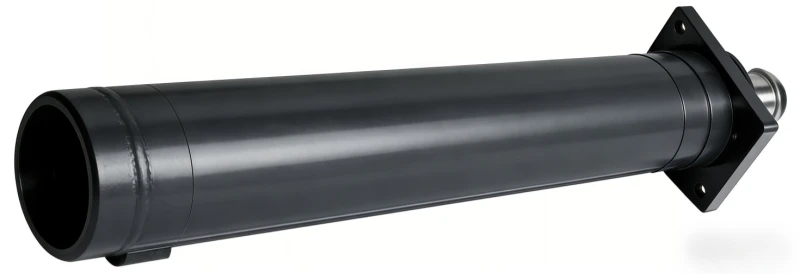
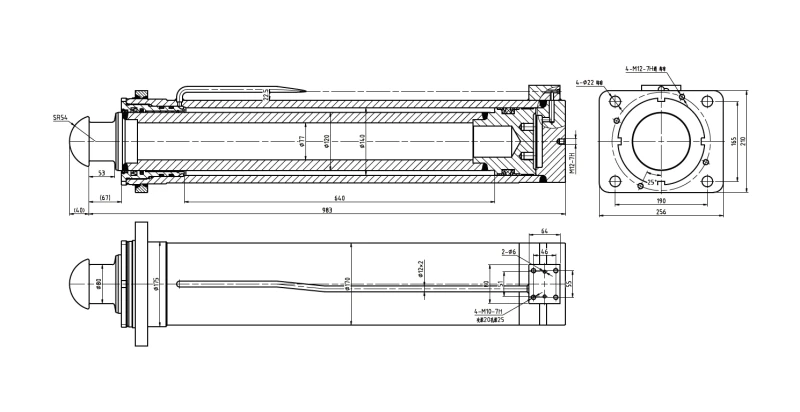
The structural body of our high-pressure cylinders is manufactured exclusively from ST52.3 (E355) high-yield strength seamless steel tubing. Unlike standard carbon steel, ST52.3 undergoes precision CNC skiving and roller burnishing to achieve an internal bore roughness of less than Ra 0.2 micrometers. This ultra-smooth mirror finish minimizes friction coefficients, dramatically lowering heat generation during rapid strokes and eliminating the stick-slip phenomenon that accelerates seal wear. The piston rod is forged from high-tensile alloy steel, subjected to induction quenching to a case depth of 1.5mm to 2.5mm, reaching an external hardness of HRC 55 to 60. This hardened core is then treated with a 50 micrometer duplex hard chrome plating layer, providing a defensive barrier against mechanical impacts and chemical corrosion.
To prevent pressure bypass and external oil leakage under working pressures up to 35 MPa, our cylinders incorporate a multi-layered sealing matrix utilizing premium Japanese NOK polyurethane components:
| Seal Component | Material Strategy | Primary Engineering Function |
|---|---|---|
| Primary U-Cup Seal | NOK Polyurethane Matrix | Maintains fluid pressure containment, preventing external oil weeping under dynamic load. |
| Buffer Ring | PTFE Composite + Elastomer | Absorbs massive pressure spikes and unmitigated shockwaves before they reach the primary seal lips. |
| Wear/Guide Bands | Phenolic Resin / Phenol-Arid | Supports heavy asymmetric side loads, eliminating metal-to-metal contact between piston and bore. |
| Scraper / Wiper Seal | Metal-Clad Polyurethane NBR | Mechanically strips away stones, sub-micron silica dust, and ice films during the rod retraction stroke. |
Our Core Technical Advantages
In a market flooded with standard aftermarket alternatives, our specialized hydraulic cylinders stand out as the definitive standard for industrial durability. Selecting the right manufacturer means choosing component security over persistent operational risk.
Bespoke Customization
Our technical department provides comprehensive custom engineering capabilities, allowing our team to seamlessly adapt designs to your specific equipment envelopes down to negative 40 degrees Celsius or marine environments.
Quality Automation
We execute multi-pass automated Submerged Arc Welding (SAW) to achieve perfect weld penetration. Every unit undergoes 100 percent hydrostatic proof pressure testing and non-destructive testing (NDT).
Optimized TCO
Integrating ST52.3 steel structures with elite Japanese NOK seals yields a 45 percent reduction in long-term maintenance costs and shields your operation from catastrophic machinery downtime.
OEM Integration
Through strategic raw material allocation and automated machining pathways, we offer highly competitive lead times for batch shipments and custom prototypes alike, minimizing market constraints.
Maintenance Protocol and Troubleshooting Diagnostics
Proactive equipment care is the single most effective methodology for extending hydraulic system life and ensuring component safety.
The primary failure mode in construction equipment hydraulics is fluid contamination. When ambient dust bypasses a worn rod wiper, it degrades oil hygiene, turning fluid into a micro-abrasive slurry. Technical teams must enforce a strict fluid sampling schedule, maintaining oil cleanliness to ISO 4406 16/14/11 standards. If fluid inspections reveal dark discoloration or milkiness, it signals thermal breakdown or water emulsification, requiring an immediate system flush and filter element swap. Furthermore, structural technicians must execute structural torque verifications on mounting pins and spherical trunnion bearings every 500 operating hours; uneven wear or looseness at these connections introduces mechanical side-loading, resulting in rapid seal destruction and localized cylinder wall abrasion.
Frequently Asked Questions
Can your hydraulic cylinders adapt to extreme cold (negative 40 degrees Celsius) or marine salt spray environments?
Yes, our cylinders are specifically engineered for these extreme environments. We integrate low-temperature nitrile or Viton seal rings and employ advanced dual-layer nickel-chromium electroplating tech to guarantee superior corrosion and thermal resilience.
What is the maximum working pressure and test pressure of your heavy-duty construction cylinders?
Our standard construction machinery cylinders operate at a nominal working pressure of 35 MPa, with a static proof test pressure reaching up to 52.5 MPa, ensuring a safety factor of 4:1 against structural failure.
What surface coating options do you provide for machinery operating in highly abrasive environments?
We offer our standard 50 micrometer hard chrome plating as a baseline defensive layer. For extreme abrasion resistance, we provide advanced options such as laser cladding, HVOF thermal sprays, and specialized high-density industrial ceramic coatings.
Can your engineering team directly process manufacturing orders from our 3D CAD files (SolidWorks/STEP)?
Yes, we accept direct file transfers across all standard formats, including SolidWorks, STEP, IGES, and AutoCAD files. Our design team executes a complete, internal engineering review to ensure tolerance matching before manufacturing begins.
Do you offer support for integrating internal displacement sensors for smart automation systems?
Yes, we provide specialized deep-hole drilling and cylinder head formatting to integrate advanced LVDT or magnetostrictive linear sensors, enabling real-world position feedback with sub-millimeter positioning accuracy.
What is your minimum order quantity (MOQ) and standard delivery lead time for custom batch orders?
We maintain highly flexible commercial terms, offering single-unit production runs for custom engineering prototypes. Standard prototype delivery spans approximately 4 to 6 weeks, while mass OEM production batches are delivered on a structured schedule matching your supply chain needs.
How do your engineers ensure that long-stroke cylinders do not experience structural buckling under full compression?
Every long-stroke linear actuator undergoes a rigorous Euler buckling calculation during the design phase. We precisely optimize the cylinder wall thickness, choose appropriate rod diameters, and integrate internal guide lengths to ensure absolute geometric stability under peak load conditions.
What validation testing protocols are executed on your components before they depart your facility?
We mandate a strict zero-leak quality matrix. Every actuator undergoes comprehensive dynamic testing, 100 percent proof-pressure static pressure hold verification, stroke friction force mapping, and internal bypass assessment, with comprehensive inspection documentation provided to the client.
What is your commercial warranty coverage standard and your procedure for technical support?
All of our heavy-duty cylinders are backed by our comprehensive 12-month industrial product warranty. Our service team remains available to assist with diagnostic inquiries, component optimization, and rapid field spare parts replacement coordination.
How do you guarantee that a newly customized actuator will integrate seamlessly with our existing machinery architecture?
During our initial design review, our technical team evaluates fluid volumetric requirements, pressure drops, port thread styles, and return line backpressure parameters, ensuring our cylinder fits the physical space envelope and matches your pump and valve parameters perfectly.
Conclusion and Strategic Action Call
The mechanical stability and overall uptime of high-capacity construction equipment depends directly on the durability of its core components. Investing in advanced material manufacturing, high-yield ST52.3 seamless barrels, and elite Japanese sealing chemistry is an investment in long-term operational profitability. When machinery operates 15 meters in the air or pulls thousands of tons of earth, component security is paramount. If you are seeking highly dependable, custom-designed hydraulic cylinder configurations engineered to survive severe working environments, look no further than our technical production division. Let us transform your design challenges into high-performance industrial assets.