.webp)
Introduction
In the unyielding environments of modern mega-farming and intensive timber harvesting, seasonal uptime is the primary benchmark dictating commercial yield and enterprise profitability. Heavy agricultural and forestry machinery—ranging from high-power articulated tractors and large-scale combine harvesters to high-torque forestry forwarders and tree fellers—must perform continuously within exceptionally tight seasonal operational windows. Corrosive fertilizer dusts, dense crop chaff, sticky wood saps, high-density mud, and severe structural shock loads define the baseline working pressures for these hard-working vehicle fleets. Under these extreme field conditions, an unexpected component failure quickly halts entire harvesting or planting sequences, causing immediate crop degradation and substantial downstream financial losses.
At the absolute core of these monumental vocational vehicles lies the fluid distribution infrastructure, where specialized hydraulic linear actuators fulfill the critical role of the primary structural muscle. Every high-accuracy steering maneuver, every heavy three-point hitch lifting sequence, and every high-impact log grasping cycle depends entirely on the mechanical output of these precision components. Transforming raw hydraulic fluid energy into perfectly stable, highly controllable, and safely repeatable linear force requires a superior standard of metallurgical strength and seal resilience. This comprehensive engineering evaluation explores the unique structural demands across agricultural and forestry actuation systems, analyzing localized load vectors, advanced material processing specifications, and proactive fleet preventative care regimens.
Core Application Scenarios Breakdown
Modern primary production machinery utilizes synchronized, multi-axis kinematics to manage high-tonnage materials and heavy tillage attachments. To maximize efficiency, specialized actuators are engineered to perform distinct, highly concentrated physical roles.
A
Heavy Tractor and Harvester Precision Steering Systems
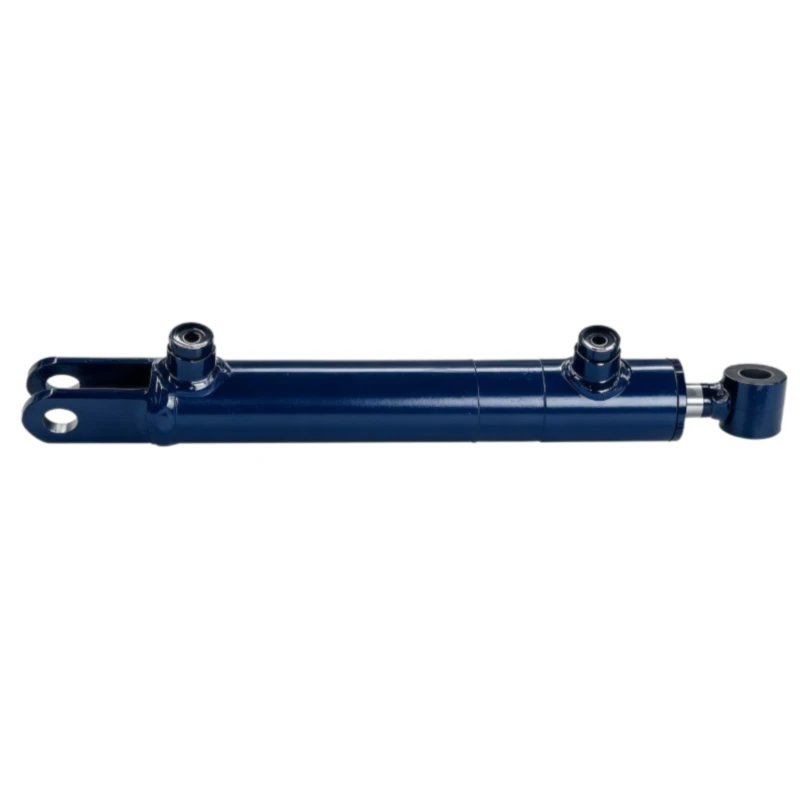
Application Description: In large four-wheel-drive articulated tractors, high-capacity combine harvesters, and automated crop sprayers, balanced hydraulic steering cylinders are integrated directly into the front axle or the central articulation pivot. These double-acting or dual-rod steering rams provide the high-torque output required to turn deep-treaded flotation tires through deep mud, wet clay, and heavily rutted soil pathways, ensuring stable tracking during field navigation.
Extreme Challenges: Precision steering actuators operate under constant structural impact conditions. When tracking across rough soil furrows or hidden field obstacles, the tractor tires encounter severe lateral resistance, sending unmitigated shockwaves straight through the steering linkage back into the piston rod. This mechanism triggers sudden, high-frequency fluid pressure spikes inside the cylinder barrel. Furthermore, being located at the lowest point of the machine chassis, the steering rod is continuously hit by flying stones, thick mud layers, and abrasive crop crop remnants.
Technical Countermeasures: To maintain perfect directional path accuracy under severe shock, steering cylinders feature high-tensile induction-hardened steel rods and reinforced gland caps. Internal mechanical cushioning blocks are paired with double-acting rod seal rings to prevent pressure bypass and protect the actuator from localized mechanical distortion.
B
Articulating Forestry Harvester Heads and Log Loaders
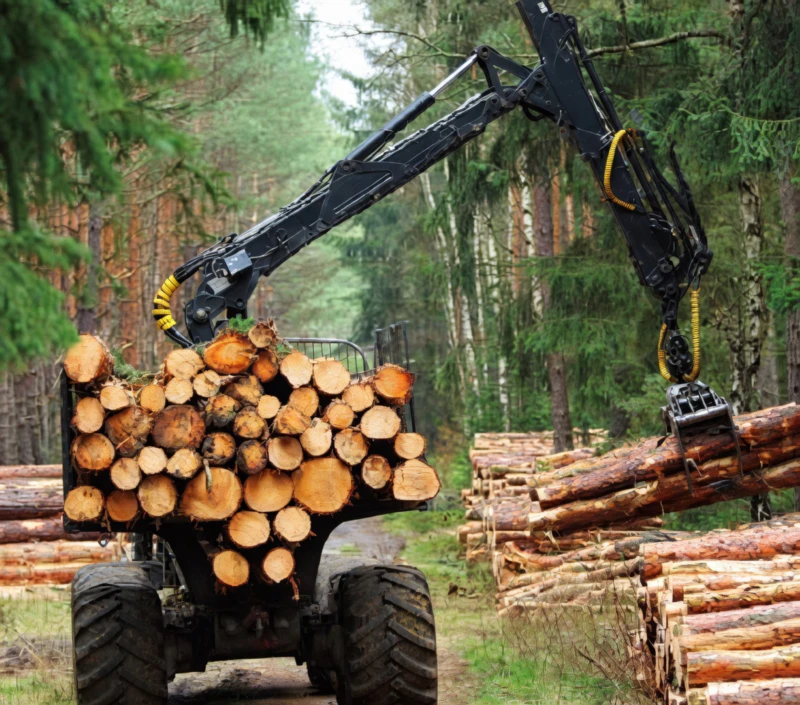
Application Description: Forestry machinery operates in some of the most aggressive conditions in the fluid power sector. Forestry harvesters and log forwarders employ a matrix of boom tilt cylinders, grapple arm cylinders, and specialized delimbing knife actuators. These heavy cylinders drive the boom structure to reach out, grab large timber stalks, position the felling saw, and feed massive logs through high-speed internal delimbing processing rollers.
Extreme Challenges: Forestry grapple and tilt cylinders are subject to intense, multi-directional bending moments and structural impacts. When a massive tree is felled, the sudden weight transition sends severe kinetic shocks back into the loader boom hydraulics, generating high fluid pressure waves. Additionally, the outer shell is constantly exposed to corrosive pine resins, tree sap, sub-zero winter temperatures, and flying bark fragments that can scratch exposed steel and quickly compromise standard industrial seals.
Technical Countermeasures: Actuators built for the forestry sector integrate extra-wide internal guide rings to distribute heavy cross-head bending forces evenly across the inner barrel walls. Piston rods receive a thick, specialized duplex hard chrome plating layer to prevent surface pitting from sticky wood resins and corrosive organic liquids.
Core Technical Specifications and Metallurgical Architecture
Engineering high-pressure vehicular cylinders capable of surviving the continuous cycle profiles and dynamic field forces of modern primary production requires absolute metallurgical discipline and advanced multi-layer sealing logic.
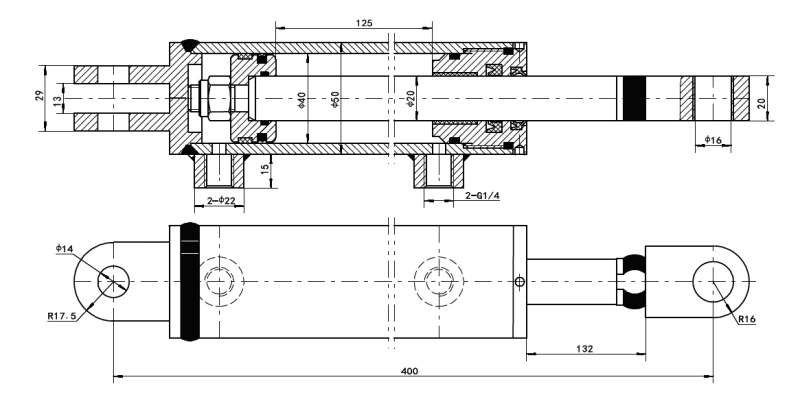
The structural framework of our specialized cylinders is forged exclusively from ST52.3 (E355) high-yield strength seamless steel tubing. This grade provides exceptional elastic resistance, preventing outer barrel swelling when encountering sudden system pressure spikes up to 35 MPa. The inner bore is finished using high-precision CNC skiving and roller burnishing to guarantee an internal surface profile below Ra 0.2 micrometers. This smooth, mirror finish establishes a stable plateaued topology that maintains a uniform hydrodynamic oil film, lowering friction heat and maximizing seal operating life. The piston rod is machined from high-tensile structural alloy steel and induction case-hardened to a depth of 1.5mm to 2.5mm, reaching an external surface hardness of HRC 55 to 60. This treatment creates a rigid barrier against stone strikes, which is then protected beneath a 50 micrometer duplex hard chrome plating layer to ensure superior resistance against chemical fertilizers and outdoor humidity.
To prevent pressure bypass and eliminate position drift under full tonnage loads, our cylinders utilize an advanced dynamic sealing matrix integrating premium Japanese NOK polyurethane polymer configurations:
| Seal Component | Material Strategy | Primary Engineering Function |
|---|---|---|
| Primary U-Cup Seal | NOK Polyurethane Matrix | Maintains positive oil containment along the moving rod shaft, eliminating external weeping across extended operating cycles. |
| Buffer Ring | PTFE Composite + Elastomer | Absorbs severe dynamic pressure spikes and fluid shock waves during heavy tool adjustments before they reach primary seal elements. |
| Wear/Guide Bands | Phenolic Resin / Phenol-Arid | Supports intense asymmetric side loads during uneven tillage or lifting maneuvers, preventing steel-to-steel inner contact. |
| Scraper / Wiper Seal | Metal-Clad Polyurethane NBR | Mechanically strips away mud cakes, abrasive silica grit, and crop chaff residues during the rod retraction movement. |
Our Core Technical Advantages
In an agricultural sector frequently challenged by baseline component longevity, our specialized production frameworks provide fleet owners and OEMs with verified field durability. Selecting our engineering division means choosing long-term asset security over constant maintenance overheads.
Bespoke Agricultural Adaptation
Our technical group delivers precision custom engineering options, modifying internal strokes, mounting geometry, and oil port positioning to integrate seamlessly with your specific implement frame layouts.
Automated Weld Processing
We leverage multi-pass automated Submerged Arc Welding (SAW) paths to establish maximum microstructural depth across critical end caps and trunnions. Every weld undergoes complete Ultrasonic Non-Destructive Testing (NDT).
Minimized Lifecycle TCO
Uniting raw ST52.3 seamless steel walls with genuine Japanese NOK polyurethanes produces a 45 percent drop in long-term fleet maintenance costs and isolates your operations from unexpected oil leaks.
Smart Positioning Telemetry
To support modern autonomous tractors and GPS-guided harvesting attachments, we support embedding absolute magnetostrictive linear displacement sensors to provide real-time automated tracking data feedback.
Maintenance Protocol and Troubleshooting Diagnostics
Proactive preventative care is the primary variable required to sustain high fluid performance and secure continuous component uptime across agricultural haulage lines.
The leading source of linear component deterioration in specialized field operations is oil breakdown driven by particulate and chemical contamination. When acidic plant juices or high-velocity harvest dust bypass an aging rod wiper, it degrades oil hygiene, turning fluid into a micro-abrasive slurry. Fleet maintenance groups must enforce a strict fluid sampling schedule, maintaining oil cleanliness to ISO 4406 16/14/11 standards. If fluid inspections reveal dark discoloration or milkiness, it signals thermal breakdown or water emulsification, requiring an immediate system flush and filter element swap. Furthermore, structural technicians must execute structural torque verifications on mounting pins and spherical trunnion bearings every 500 operating hours; uneven wear or looseness at these connections introduces mechanical side-loading, resulting in rapid seal destruction and localized cylinder wall abrasion.
Frequently Asked Questions
Can your hydraulic cylinders adapt to chemical fertilizer dust or sticky forestry wood resins?
Yes, our agricultural and forestry actuators are engineered for these specific harsh environments. We integrate specialized nitrile or fluorocarbon seal rings and employ advanced dual-layer nickel-chromium electroplating tech to guarantee superior corrosion resistance against active chemical compounds and aggressive wood saps.
What is the maximum working pressure and test pressure of your heavy-duty steering and hitch cylinders?
Our standard agricultural cylinders operate at a nominal working pressure of 35 MPa, with a static proof test pressure reaching up to 52.5 MPa, ensuring a structural safety factor of 4:1 against high pressure surges when hitting deep field ruts.
What surface coating options do you provide for machinery operating in highly abrasive soil conditions?
We offer our standard 50 micrometer hard chrome plating as a baseline defensive layer over induction-hardened steel (HRC 55-60). For extreme abrasion resistance, we provide advanced options such as laser cladding, HVOF thermal sprays, and specialized high-density industrial ceramic coatings.
Can your engineering team directly process vehicle manufacturing orders from our 3D CAD files (SolidWorks/STEP)?
Yes, we accept direct file transfers across all standard formats, including SolidWorks, STEP, IGES, and AutoCAD files. Our design team executes a complete, internal engineering review to ensure tolerance matching with your equipment frame layouts before manufacturing begins.
Do you offer support for integrating internal displacement sensors for smart automated tractors or robotic harvesters?
Yes, we provide specialized deep-hole drilling and cylinder head formatting to integrate advanced LVDT or magnetostrictive linear sensors, enabling real-world position feedback with sub-millimeter positioning accuracy for automated vehicle guidance systems.
What is your minimum order quantity (MOQ) and standard delivery lead time for custom implement batch orders?
We maintain highly flexible commercial terms, offering single-unit production runs for custom engineering prototypes. Standard prototype delivery spans approximately 4 to 6 weeks, while mass OEM production batches are delivered on a structured schedule matching your supply chain needs.
How do your engineers ensure that long-stroke agricultural cylinders do not experience structural buckling under compression?
Every long-stroke linear actuator undergoes a rigorous Euler buckling calculation during the design phase. We precisely optimize the cylinder wall thickness, choose appropriate rod diameters, and integrate internal guide lengths to ensure absolute geometric stability under peak load conditions.
What validation testing protocols are executed on your vehicular components before they depart your factory?
We mandate a strict zero-leak quality matrix. Every actuator undergoes comprehensive dynamic testing, 100 percent proof-pressure static pressure hold verification, stroke friction force mapping, and internal bypass assessment, with comprehensive inspection documentation provided to the client.
What is your commercial warranty coverage standard and your procedure for machinery fleet technical support?
All of our heavy-duty cylinders are backed by our comprehensive 12-month industrial product warranty. Our service team remains available to assist with diagnostic inquiries, component optimization, and rapid field spare parts replacement coordination to limit vehicle downtime.
How do you guarantee that a newly customized steering or lift cylinder will integrate seamlessly with our vehicle’s main hydraulic valve blocks?
During our initial design review, our technical team evaluates fluid volumetric requirements, pressure drops, port thread styles, and return line backpressure parameters, ensuring our cylinder fits the physical space envelope and matches your vehicle pump and valve parameters perfectly.
Conclusion and Strategic Action Call
The mechanical stability and overall uptime of high-capacity farming and forestry equipment depends directly on the durability of its core components. Investing in advanced material manufacturing, high-yield ST52.3 seamless barrels, and elite Japanese sealing chemistry is an investment in long-term operational profitability and field service stability. When machinery operates in vast fields or hoists heavy timber logs under dynamic operational postures, component security is paramount. If you are seeking highly dependable, custom-designed hydraulic cylinder configurations engineered to survive severe working environments, look no further than our technical production division. Let us transform your design challenges into high-performance industrial assets.