.webp)
The 2026 Engineering Standard for High-Altitude Actuators: Exploring Precision Luffing, Telescopic Stability, and Mission-Critical Safety Systems.
In the high-stakes environment of aerial construction and maintenance, hydraulic integrity is the only barrier between operational success and catastrophic failure. As boom heights exceed 50 meters, the hydraulic cylinder transitions from a simple hoist to a safety-critical structural stabilizer.
At tiltcylinder.net, we engineer our Aerial Work Platform (AWP) series with a “Zero-Failure” philosophy. Whether it is a main boom luffing ram, a telescopic extension actuator, or a precise platform leveling cylinder, these components must manage immense leverage and dynamic wind loads with unwavering rigidity. Our EPYY series addresses the fundamental physics of high-altitude stress—eliminating micro-creep, resisting columnar buckling, and ensuring smooth, synchronized movements for operators working at extreme heights. This guide provides an exhaustive analysis of the engineering mastery required to power the world’s safest and most productive aerial lifting fleets.
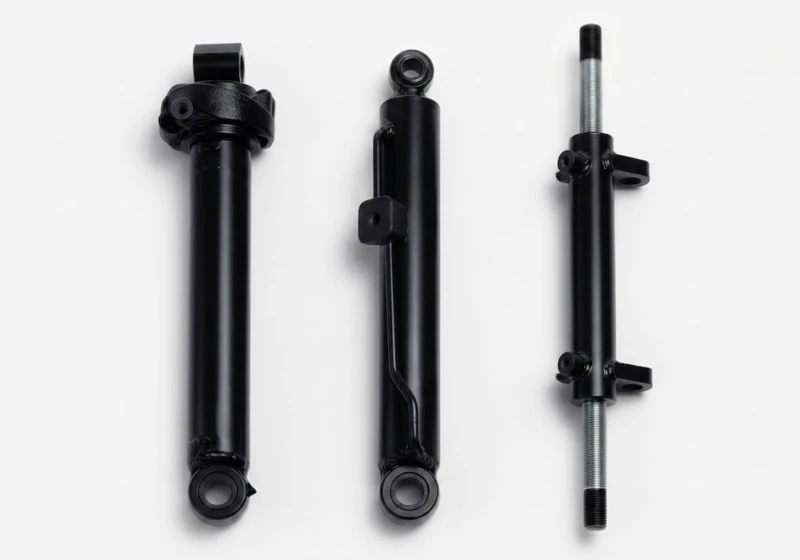
The Architecture of Stability: Overcoming Columnar Buckling
When a telescopic boom is fully extended, the extension cylinder becomes a long, slender column subjected to massive compressive loads. The primary engineering challenge in this scenario is columnar buckling—where the rod deflects laterally under load. In standard AWP cylinders, a minor deflection can lead to “stick-slip” movement or, in extreme cases, permanent deformation of the rod.
To combat this, the EPYY series utilizes a high rod-to-bore ratio and Induction-Hardened 45# Steel. By optimizing the rod diameter, we maximize the moment of inertia, ensuring the cylinder remains perfectly linear even when supporting a platform at maximum horizontal outreach. This structural rigidity is further enhanced by our Integrated Counterbalance Valves, which provide hydraulic locking to prevent uncontrolled boom descent in the event of a hose failure—a non-negotiable requirement for EN280 and ANSI A92 safety compliance.
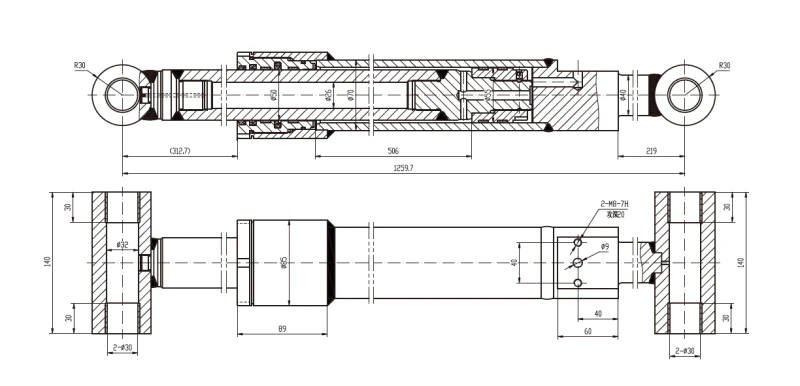
Mirror-Bore Technology: Reducing the Friction Coefficient
High-altitude work requires ultra-smooth actuator response. Any “judder” at the cylinder level is amplified ten-fold at the end of a 40-meter boom, creating a dangerous swaying sensation for the operator. This phenomenon is often caused by high breakaway friction (stiction) in the piston seals. While budget cylinders use standard honing, we employ CNC Skiving and Roller Burnishing.
Our process achieves an internal surface finish of Ra 0.2µm. This mirror-like surface allows the Japanese NOK seals to glide with minimal resistance, ensuring that luffing and leveling movements are fluid and precise. Lower friction also results in a significant reduction in heat generation, which preserves the viscosity of the hydraulic oil and prevents the thermal degradation of the sealing matrix during high-cycle urban maintenance tasks.
EPYY Core Engineering Advantages
Integrated Safety
Every AWP cylinder is pre-fitted with calibrated counterbalance valves to ensure 100% load-holding security in case of pressure loss.
Zero-Drift Matrix
Utilizing premium Japanese NOK seals and Ra 0.2µm bores to eliminate “mast creep” and maintain platform elevation for days.
High-Yield Steel
Forged from ST52.3 seamless tubing to prevent barrel swelling under the extreme luffing pressures of high-reach booms.
Salt-Spray Proof
50µm hard chrome plating and 96-hour neutral salt spray validation for offshore and high-humidity coastal deployments.
Urban Infrastructure Maintenance: The Precision Advantage
In congested urban environments, utility workers use truck-mounted aerial platforms to service power lines and smart-city infrastructure. These tasks require the machine to operate in close proximity to live voltage and expensive architectural glass. Any unexpected “kick” or “shudder” in the hydraulic extension can lead to catastrophic property damage or electrical arcing.
The EPYY Precision Solution: Our platform leveling cylinders and jib actuators are equipped with proprietary cushioning technology. This “Soft-Stop” end-of-stroke damping prevents the jarring impact that occurs when a boom reaches its limit. By smoothing the deceleration curve, EPYY cylinders provide the operator with total control, allowing for the sub-millimeter positioning required for delicate electrical work. This precision significantly increases the safety rating of municipal fleets while reducing the mental fatigue of the operators.
.webp)
Extreme Construction: Articulated Stability in High-Wind Zones
On skyscraper construction sites, articulating boom lifts are subjected to massive wind loads. As the boom bends under the force of the wind, the main luffing cylinder must absorb dynamic shocks while holding the platform steady. Standard actuators often experience internal bypass under these conditions, leading to mast descent and dangerous platform oscillations.
The EPYY Resilience Strategy: Our AWP series is designed for Surge Redundancy. While the rated working pressure is 20MPa, the ST52.3 barrel architecture is built to withstand surge peaks of up to 35MPa. This “hydraulic fuse” ensures that if a sudden wind gust strikes the boom, the cylinder will not fail or swell. Furthermore, our use of induction-quenched rods (HRC 55) prevents the micro-bending that causes seal leaks, ensuring that high-reach construction fleets maintain a 99.9% uptime record in even the most challenging climates.
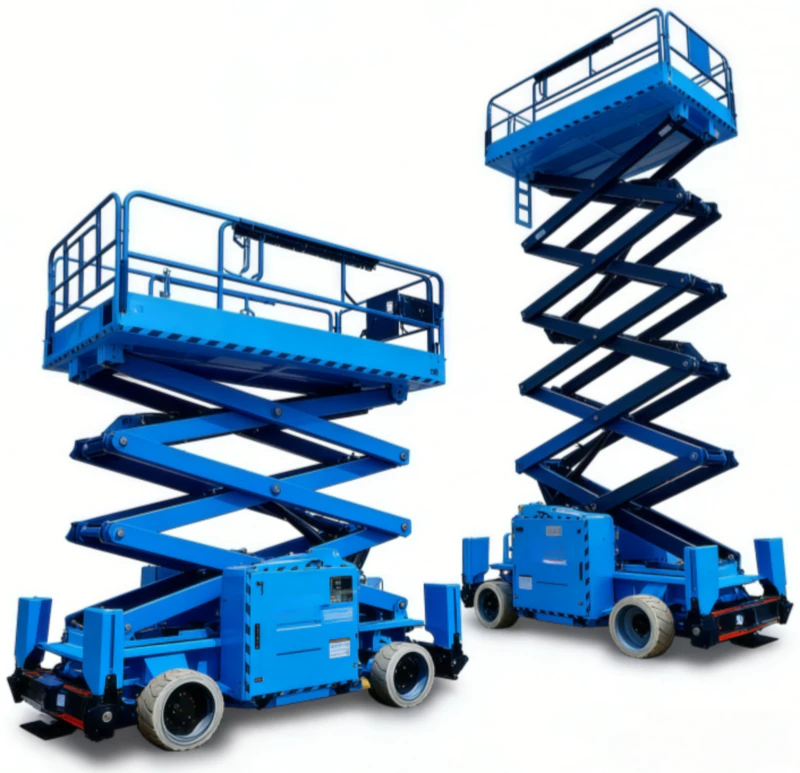
Manufacturing Standards: The Rigor of Automation
When human lives are suspended 40 meters in the air, the margin for manufacturing error is zero. Our production facility is a benchmark for Industry 4.0 Hydraulic Fabrication. From the robotic submerged arc welding (SAW) of trunnion mounts to the fully automated CNC skiving of the cylinder tube, every critical process is governed by a digital twin monitoring system. This ensures that every cylinder—from the smallest steering ram to the largest luffing jack—meets a standardized quality baseline that is verified by 100% Ultrasonic Non-Destructive Testing (NDT).
.webp)
Economic Strategy: Optimizing Lifecycle TCO
In the rental industry, a machine’s profitability is dictated by its maintenance-free days. While budget cylinders can reduce the initial CAPEX by 10%, they typically double the Total Cost of Ownership (TCO) through frequent seal failures and rod re-chroming. By investing in the EPYY series, fleet managers achieve a 50% reduction in unplanned maintenance cycles. To maintain this performance, we recommend the following 1,500-hour technical protocol:
- Seal Matrix Hydration: During long periods of storage, cycle the cylinders weekly to keep the NOK polyurethane seals hydrated and elastic.
- Wiper Dust Protection: Inspect the rod wiper daily. In desert or dusty construction sites, a cracked wiper allows abrasive silica to enter the seal gland, leading to premature bore erosion.
- Cavitation Prevention: Always perform a full-stroke “De-Aeration” cycle (5 times) after any hydraulic line maintenance to ensure firm boom response.
- Fluid Dielectric Check: For insulated boom units, ensure the hydraulic fluid meets the required dielectric strength to maintain insulation properties.
Conclusion: The Hydraulic Foundation of Altitude Safety
As we move further into 2026, the reliance on high-reach aerial equipment continues to expand across urban planning, telecommunications, and green energy maintenance. The hydraulic cylinder remains the critical link in the chain of safety. At tiltcylinder.net, we combine world-class metallurgy, Japanese sealing technology, and rigorous automated manufacturing to provide the actuators that ensure every worker returns home safely from the clouds. Our EPYY series is not just a component; it is the foundation of high-altitude confidence.
Secure Your Fleet’s Future in the Clouds
Eliminate hydraulic sway and mast drift from your operations. Connect with our engineering team for custom AWP solutions or high-volume OEM support.
100% Safety Tested
ANSI A92 Compliant
Worldwide Logistics