.webp)
The 2026 Engineering Standard for High-Tonnage Actuators: Exploring Lattice Boom Luffing, Frame Support Stability, and Extreme Load Resilience.
In the world of heavy lifting, the crawler crane represents the pinnacle of mobile mechanical leverage. As these machines scale to lift over 3,000 tons, the hydraulic cylinder transitions from a supporting component to the primary structural fail-safe.
At tiltcylinder.net, we engineer our Crawler Crane series with a “Deflection-Zero” philosophy. Whether it is a massive luffing ram managing the angle of a 100-meter lattice boom or a frame support cylinder establishing the machine’s leveling on uneven terrain, these actuators must handle colossal static and dynamic forces. Our EPYY series is architected to eliminate the industry’s most persistent risks: cylinder buckling under compression, seal failure during high-pressure hold cycles, and metallurgical fatigue in extreme environments. This guide provides an exhaustive analysis of the engineering mastery required to power the world’s most capable infrastructure-building fleets.
The Metallurgy of Heavy Lift: ST52.3 and Beyond
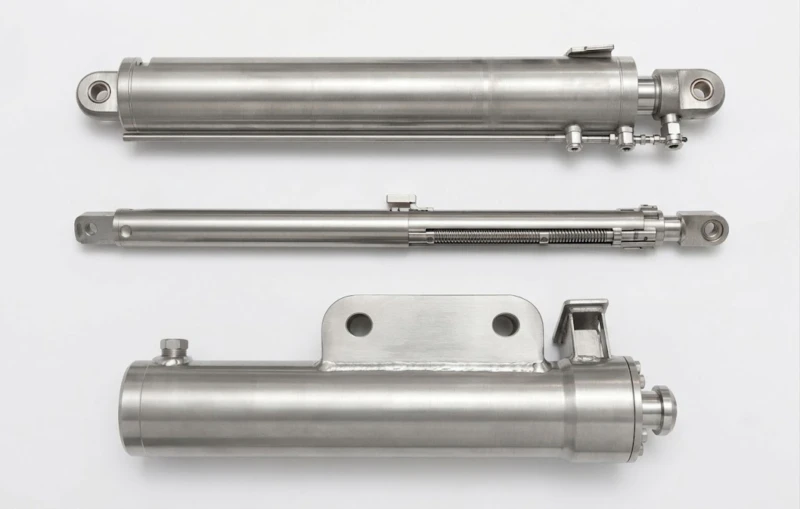
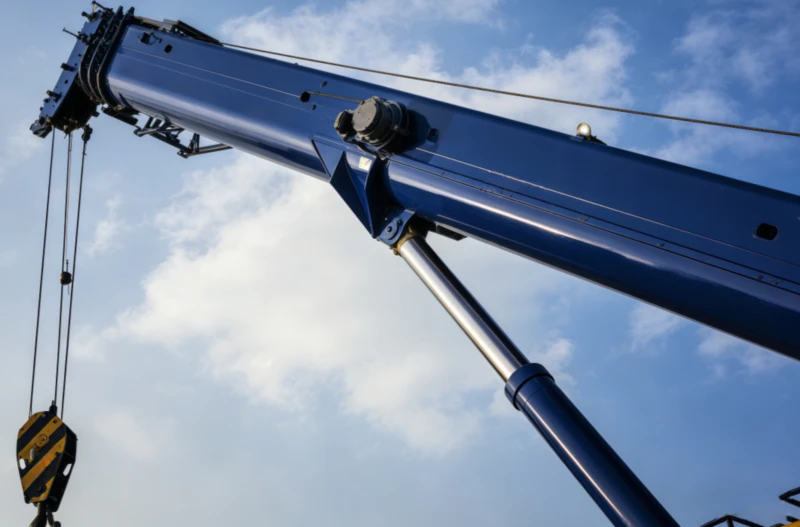
For crawler cranes, the luffing cylinder (mast angle cylinder) is subjected to immense compressive stress when the boom is at a low angle. Standard aftermarket cylinders often suffer from “columnar deflection,” where the rod begins to bow micro-radially under load, causing catastrophic side-loading on the internal wear rings. This leads to premature seal failure and potential structural collapse.
To eliminate this, the EPYY series utilizes ST52.3 (E355) high-yield strength seamless steel specifically treated for high-tonnage applications. Unlike standard steel, ST52.3 provides the uniform molecular density required to prevent “barrel swelling” when internal pressures reach 30MPa. Every luffing actuator is designed with a high rod-to-bore ratio, utilizing induction-hardened rods (HRC 55) to maximize the moment of inertia and ensure the rod remains perfectly linear even under maximum compression.
Burnished Bore Technology: Achieving the Zero-Drift Matrix
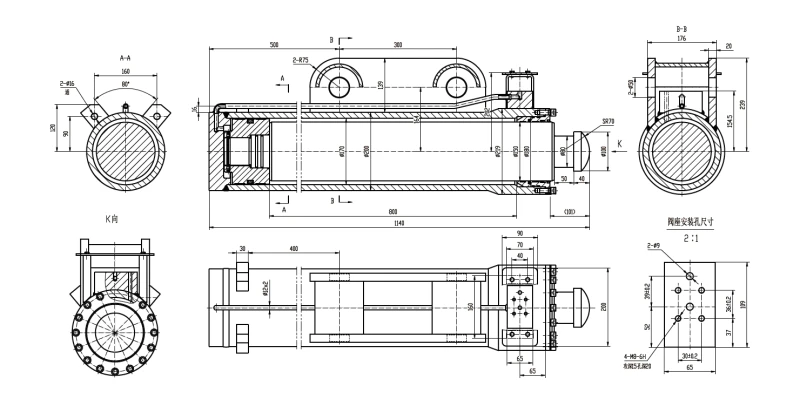
In lattice boom operations, load positioning must be static for long durations (e.g., during nuclear reactor containment placement). Any internal fluid bypass in the luffing cylinder results in mast drift, which can be fatal. While traditional honing creates microscopic “peaks” that wear out seals, we utilize CNC Skiving and Roller Burnishing.
Our burnishing process cold-works the internal bore wall, increasing its surface hardness while achieving an Ra 0.2µm mirror finish. This ultra-smooth surface allows our Japanese NOK multi-lip seals to operate with minimal friction and zero bypass. The result is a “Zero-Drift” hydraulic hold, ensuring the crawler crane’s boom stays locked at the exact programmed angle without the need for constant hydraulic adjustment.
The EPYY Heavy-Lift Advantage
30MPa Load Capacity
Engineered from high-yield ST52.3 seamless tubing to prevent barrel swelling under the extreme pressures of lattice boom luffing.
Zero-Drift Sealing
Utilizing premium Japanese NOK seals and mirror-burnished bores to ensure absolute angle retention during heavy load holds.
Anti-Corrosive Shield
50µm hard chrome plating and optional epoxy coating survive 96-hour salt spray tests for offshore wind farm deployment.
Pin-Point Precision
Internal rod damping and Soft-Stop technology prevent the boom-judder that causes dangerous load sway during luffing.
Mega-Infrastructure: Stability in Nuclear and Bridge Construction
In the construction of bridge pylons or nuclear containment structures, crawler cranes are the workhorses. Here, the frame support cylinder (jack cylinder) is tasked with maintaining a perfectly level machine chassis. If the soil shifts slightly under the crawlers, the jack cylinder must adjust dynamically.
The EPYY Stability Matrix: Our frame support series is designed with integrated load-holding check valves. Even if a hydraulic line is ruptured by falling debris, the cylinder remains mechanically locked, preventing the machine from tilting. This safety redundancy is why EPYY cylinders are the preferred choice for EPC contractors managing high-risk infrastructure projects. The massive Φ300mm+ bore provides the vertical lift capacity required to level cranes with counterweight packages exceeding 500 tons.
Renewable Energy: Wind Farm Deployment in Harsh Climates
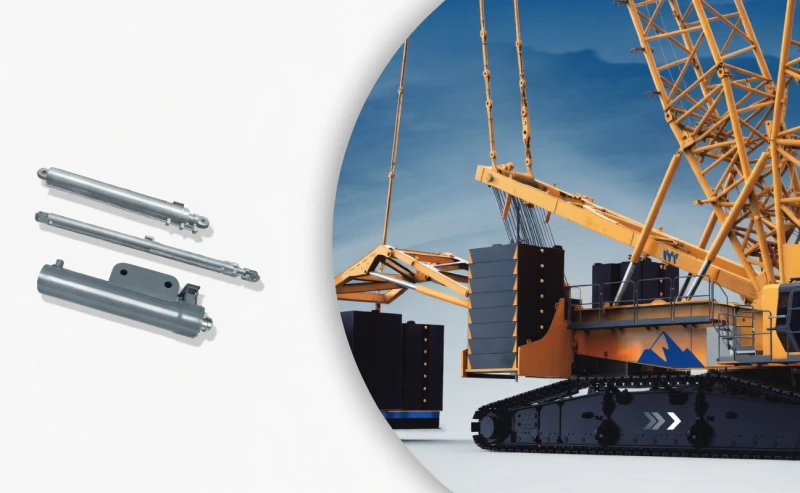
Erecting wind turbines on remote, wind-swept mountain ridges or soft marshland requires crawler cranes to operate at the edge of their tipping charts. The main boom angle cylinder is subjected to massive dynamic wind gusts that strike the boom lattice, creating sudden pressure spikes in the hydraulic circuit.
The EPYY Resilience Strategy: Every AWP and crawler cylinder in the EPYY series is tested for Shock Redundancy. While rated for 20MPa, the ST52.3 barrel architecture can withstand surge peaks of 35MPa without permanent deformation. For offshore wind farms, we add a specialized induction-hardened rod treatment survived 96-hour salt spray tests, ensuring the cylinder rods never experience the pitting corrosion that leads to catastrophic seal leakage in coastal climates.
Manufacturing Excellence: Forging Trust through Automation
When human lives and multi-million dollar turbine nacelles are suspended in the air, there is no room for human error in manufacturing. Our production facility is a benchmark for Industrial 4.0 Hydraulic Fabrication. Every critical weld on a Crawler Crane cylinder is performed by multi-pass robotic SAW (Submerged Arc Welding) units, ensuring deeper penetration and zero porosity compared to manual welding. Each unit is subject to 100% Ultrasonic Non-Destructive Testing (NDT), a non-negotiable standard that separates EPYY from budget aftermarket providers.
.webp)
Economic Strategy: Optimizing Fleet TCO
In the heavy rental and EPC sectors, a crawler crane’s profitability is measured by its “availability.” A cylinder failure can ground a 500-ton crane for weeks, costing the owner upwards of $50,000 in lost revenue and mobilization costs. By investing in the EPYY series, fleet managers achieve a 50% reduction in unplanned maintenance events. To preserve this lifecycle ROI, we recommend the following 2,000-hour technical protocol:
- Hydraulic Fluid Hygiene: Maintain oil to ISO 4406 16/14/11. Suspended particulates act like liquid sandpaper on the mirror Ra 0.2µm bore.
- Rod Seal Lubrication: During long periods of boom-up operation, the exposed rod should be inspected daily for abrasive grit that can compromise the wiper seal.
- Pressure Hold Validation: Perform monthly static load holds to verify the integrity of the integrated counterbalance safety valves.
- NDT Recertification: For cranes over 10 years old, we recommend ultrasonic weld inspections during major machine overhauls.
Conclusion: The Hydraulic Link to Global Progress
As global infrastructure projects reach new heights and weights in 2026, the reliance on high-tonnage crawler cranes has never been more absolute. The hydraulic cylinder remains the critical, physical link in the chain of safety. At tiltcylinder.net, we combine world-class ST52.3 metallurgy, Japanese sealing excellence, and rigorous automation to provide the actuators that ensure every mega-lift is performed with absolute confidence. Our Crawler Crane series is more than a product; it is the foundation of structural progress.
Power Your Mega-Lift Projects Today
Eliminate hydraulic drift and mast deflection from your fleet. Connect with our engineering team for custom crawler designs or high-volume OEM support.
100% Load Tested
Worldwide Heavy Logistics
OEM Ready